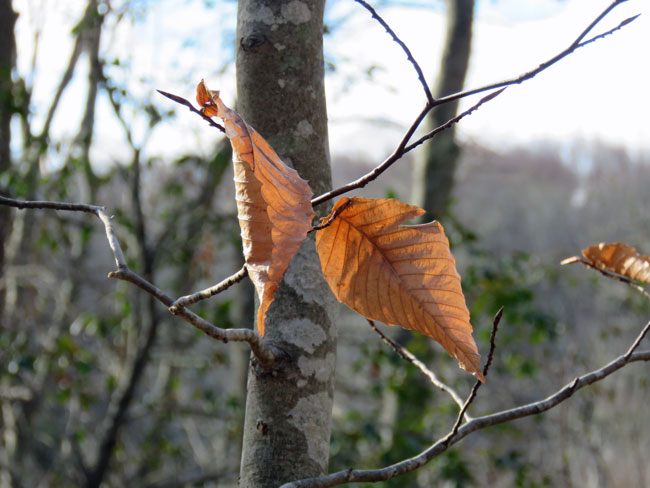
Within the grip of winter, it is almost impossible to imagine the spring. The gray perished landscape is shorn of color. Only bleakness meets the eye; everything seems severe and edged. Winter is the oldest season; it has some quality of the absolute. Yet beneath the surface of winter, the miracle of spring is already in preparation; the cold is relenting; seeds are wakening up. Colors are beginning to imagine how they will return. Then, imperceptibly, somewhere one bud opens and the symphony of renewal is no longer reversible. From the black heart of winter a miraculous, breathing plenitude of color emerges. ~ John O’Donohue (To Bless the Space Between Us)
Groundhog Day was one of our favorite holidays. We had a tradition of taking our groundhog stuffy outside to see (or to not see) his shadow. We named him Basil (Wasyl) after my grandfather, who was born in Ukraine on February 2, 1882. By 2014 Basil had a companion, who was at first named Basil, Jr. At some point Tim, with his endless sense of humor, started calling the little one Oregano, and it stuck.
I cannot bear to continue this tradition without my beloved. So I decided to dig up some of the pictures I took of it over the years, in memory of Tim. I am definitely within the grip of winter, the one outside and a winter of grief. I still can’t imagine how a future without him will ever feel like spring.
Tim, Oregano & Basil bird-watching together (2025, Bolin Forest) this turned out to be our last Groundhog Day together
definite shadows (2024, North Carolina Botanical Garden)
Tim waiting for the parade to begin with Basil & Oregano (2023, Essex Ed Groundhog Day Parade)
fun in the snow (2022, Haley Farm State Park)
by the sea (2019, Eastern Point Beach)
Tim waiting with the Basils (2014, Essex Ed Groundhog Day Parade)
Basil, Oregano and I will stay inside and light a candle this year.
2.2.25 ~ Bolin Forest, Groundhog Day (no shadows at first)
On Groundhog Day last year we took our groundhogs, Basil & Oregano, to the botanical garden to check on their shadows, so this year we decided to take them out into the woods. Our friend Susan joined us for a nice long walk down by our neighborhood’s Bolin Creek.
The weather was chilly, cloudy, damp and gray. It had been raining recently so there was plenty of mud along the path, making for some dicey footing. Susan spotted a red-shouldered hawk who visited a couple of trees before settling on one where I could get a picture.
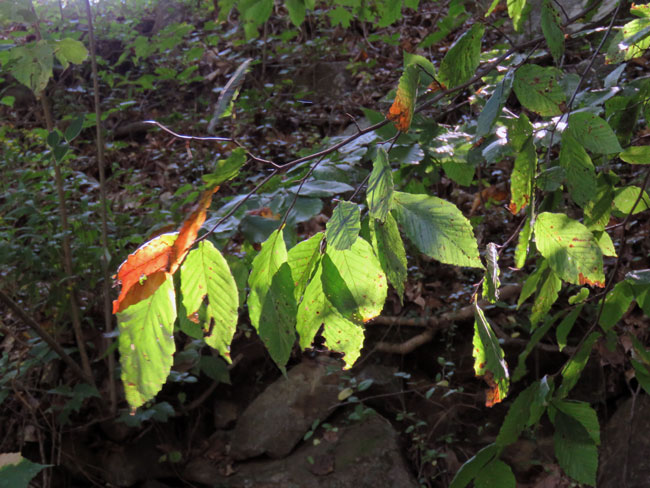
Only the beech trees and their marcescent leaves, looking like sand or wheat, bring light to such dark, wet woods, standing out vividly among the dark-gray oak and hickory trunks and the cyanine green of the cedars. A few of our beech trees are large and well spread out, but many more are saplings, six to twelve feet high, present and proud and serving as fine, multifaceted reflectors. ~ Bland Simpson (Clover Garden: A Carolinian’s Piedmont Memoir)
A funny thing happened after a couple of joggers passed by us. Apparently it took them some time to realize what their eyes had just seen. (A grown man carrying two stuffed groundhogs.) They stopped running, looked back around and one called out to us, “Wait a minute! Is it Groundhog Day?” We all had a good laugh.
Tim, Oregano & Basil bird-watching together
Bolin Creek was gurgling away, pleasantly full of water and sounding so very soothing.
The sky was so gray, but then, as we started heading back home, the sun made an effort to break through, lighting up the beech leaves…
“fine, multifaceted reflectors”
… and making the creek’s water sparkle in a few spots. So we had Oregano & Basil pose for a second Groundhog Day photo.
(shadows!)
Looking at pictures of our groundhogs’ shadows back in Connecticut I happened to notice that they were a lot longer than the ones down here.
2.2.19 ~ Eastern Point Beach Groton, Connecticut
AI Overview tells me that “shadows are generally longer in the winter, especially in locations further north, because during winter the Northern Hemisphere is tilted away from the sun, causing the sun to appear lower in the sky and cast longer shadows; the further north you go, the more pronounced this effect will be.” I find this so fascinating!
10.18.24 ~ Pritchard Park Chapel Hill, North Carolina
There’s hardly a spot of color on the hardwood trees in our yard, but the light is glorious, as it always is in October, and the signs of fall are unmistakable. ….. Always, when nature works as nature must, there are joys for every grief, a recompense for every sorrow. ….. Night falls earlier with each passing day now, but the recompense of shorter days is the glorious light of October. I wish you could see what happens to the magnificent colors of berry and bird and flower in the slanting light of October. ~ Margaret Renkl (The New York Times, October 14, 2024, “Growing Darkness, October Light: A Backyard Census”)
These pictures were taken on Friday morning, the day we stood in line at the Chapel Hill Public Library to vote. Afterwards we took a walk on the trails in the woods surrounding the library. North Carolina has early voting, something new to us. Before we left Connecticut we had voted in favor of bringing early voting to our old state. I wonder if it passed. Our habit was to get up early on election day and get to the polling place before it opened. We were always near first in line.
Something new for the citizens of NC is having to show a photo ID when they check in to vote. We always had to do that back in CT. It’s so interesting getting to know the different ways the governments of different states run things, something I never thought about before, having lived in only one state my whole life.
As I stood in line I reflected on how encouraging it was to learn that our 39th President, Jimmy Carter, made the effort to vote while in hospice care at the age of 100. He was the first president I ever voted for. My thoughts also returned to the sacrifice so many of our ancestors made for us in the Revolutionary War, so that we could have the right to vote today. As the granddaughter of Ukrainian immigrants on one side and the descendant of several Mayflower passengers on the other, my complex place in American history has always fascinated me. While appreciating the myriads of reasons Europeans have crossed the Atlantic over the centuries to make better lives for themselves here, I also feel deep regret for the harm they have caused to the original people who lived, and still live here.
When we moved down here I started looking for southern nature writers who might help me get acquainted with my new environment. I’ve become a big fan of Margaret Renkl, who lives in Tennessee at the same southern latitude as we do. Her lyrical writings resonate with the seasonal observations I’m experiencing here. I’ve read three of her books, checked out from the same beautiful library where we voted, and enjoy her occasional editorials in the New York Times.
I tried to capture some of the slanting light of October to match Renkl’s words. This is our second autumn down south and the way it is unfolding feels much more familiar now, it’s starting to feel more like home.
sculpure at Chapel Hill Public Library parking lot
5.24.23 ~ Tim on the Charles W. Morgan Mystic Seaport, Mystic, Connecticut
A year ago we were busy packing up to move to North Carolina and visiting as many of our favorite places in Connecticut as we could get to before we had to leave. This post was meant to be about the last one of those visits, but I ran out of time to get it written and posted. Mystic Seaport is an amazing living history maritime museum and it was also the venue for many special exhibits, performances and festivals that we enjoyed over the years.
stern of the Charles W. Morgan
The Charles W. Morgan is the main attraction, the last wooden whaleship in the world, and a National Historic Landmark. (more information here) It was a 15-minute drive from our home and we were long-time members of the Seaport. In fact, my parents were members and brought me here often when I was growing up, when we lived an hour away.
deck prism lying flush in the deck, it refracts and disperses natural light into the space below deck
harpoons tucked under a ceiling
ship’s wheel
luxury for the captain
captain’s quarters
first and second mates’ shared quarters
Life onboard consisted of long periods of boredom; for weeks, even months, no whales would be seen. The crew would repair gear, write letters, play games and music, and carve scrimshaw — pieces of whale bone or tooth — to pass the time. ~ New Bedford Whaling website
Whaling voyages lasted about three years. I was watching Space: The Longest Goodbye on PBS’s Independent Lens the other night. NASA is concerned about the mental health of astronauts being separated from their families for a three-year mission to Mars. The space explorers are not going to able to communicate with loved ones in real time! As if families have never had to do this before… Many of my ancestors did.
crew’s quarters
deck prism bringing in light below deck
whale blubber was cooked in big iron pots above deck, the extracted oil was stored in casks below deck
port side of the Charles W. Morgan
Every year on July 31-August 1 there is an overnight event on the Morgan, a marathon reading aloud of Moby Dick by Herman Melville. I regret we never managed to participate! In the Seaport Village, Schaefer’s Spouter Tavern was named for the one found in the classic American novel.
many pleasant summer evenings we spent outside dining and listening to live acoustic musicians performing outside at Spouter Tavern
Our final visit to the Seaport would not be complete without a visit to the Small Boats building.
spritsail boat built by my 2nd-great-granduncle, Edward Ellsworth Swift (1861-1964)
I was 7 years old when Uncle Ed died at the age of 102. My grandparents, the late Mr. & Mrs. John E. White mentioned above, took care of Uncle Ed & Aunt Flora in their old age. My grandparents were also caring for my great-grandparents at the same time and I well remember our countless visits to the six of them at the house on School Street in Woods Hole on Cape Cod.
I will miss my visits to the little boat my grandparents donated to the Seaport, which connects me across time to my ancestors.
So many memories: live music performances we attended, the visits of the Íslendingur (2000) and the Draken Harald Hårfagre (2016) Viking ships and how excited we were when the Draken decided to stay, the yearly By Land & By Sea Antique Vehicle Show, the exciting Viking Days encampment, the restorations of the Mayflower II and the Amistad, making and printing our own Christmas cards at the village Print Shop, watching costumed historians cooking on open hearths, blacksmiths at work in the forge, and so many more. The Sargent, Whistler, & Venetian Glass: American Artists & The Magic of Murano special exhibit we saw in February 2023 was unforgettable!
image credit: Ukrainian Dancers USA ~ 8.20.22
An extra special memory is an Arts on the Quad evening, when we took Katherine to see Ukrainian dancers at Mystic Seaport, seen above performing on the porch of the Thompson Exhibition Building. We were so very lucky to live so close to this treasure trove of history and culture. It is deeply missed.
9.15.23 ~ Bolin Creek Trail Chapel Hill, North Carolina
At last, walking weather arrived Friday morning! We decided to try Bolin Creek Trail. It was a pleasant enough walk, but it was paved, which is hard on Tim’s back and hip. He needs uneven terrain to walk at all comfortably. And there were many joggers out and lots of people. There were cars zooming by on the road on the other side of the creek. It didn’t feel at all like a walk in the woods!
a burl on a loblolly pine tree
Still, we were delighted to be out getting some fresh air and moving our bodies for an hour. I doubt this will become one of our favorite walks but it was nice to get more familiar with what we have for options in our vicinity.
Hurricane Florence must have been a doozy back in 2018. Apparently Bolin Creek floods quite frequently but I haven’t been able to find out how high it was during that storm. I was standing on stairs leading up to the road to get the next three pictures. The tunnel goes under another road.
Tim standing under the high water mark (see sign below)
There were some interesting tree roots along the mostly shaded creek.
bits of sunshine poking through the leaves
playing hide and seek with this squirrel can you find him?
very tiny hemlock sapling trying to grow in the dark understory
Like Gold Park in Hillsborough that we visited a month ago, this trail had an urban feel to it. I think we’re going to have to venture farther from home to find some more woodsy walks to explore. I’m getting excited and hopeful about the possibilities.
Today we’ve been married for 48 years, or as Tim is saying, it is our four dozen anniversary. 🎕 It was a small, down-to-earth and unpretentious wedding, outside, of course, in the garden of a justice of the peace.
Beverly & Barbara
My sister was my maid-of-honor, shown here at the small reception my parents hosted in their back yard. As I’ve mentioned before, my little sister grew up to be taller than me. For a couple of years we were the same height and were often mistaken for twins.
I found it!
While sorting through all our stuff last month I came across my mini wedding album. I hadn’t seen it for years and was happy to discover that it hadn’t been lost as I had assumed.
Tim often introduces me as his first wife, which still makes me smile. His sense of humor is one of the many things I still love about him, after all these dozens of years. 💕
This was the closest I have ever gotten to a brant! He was all by himself. It felt good to get outside and get a fresh perspective along with some fresh air.
1.22.23 ~ Leo Antonino Preserve, Groton, Connecticut first brook crossing on the yellow trail
On a cold and cloudy winter morning we decided to explore a relatively new open space property pretty close to home. Leo Antonino Preserve was acquired by the Avalonia Land Conservancy in 2018. What a pleasant surprise we had as we meandered along the loop trail, so many twists and turns, ups and downs and bubbling brooks to cross. We haven’t had any accumulating snow this January, not even a coating. But the woods did smell like winter and the crisp cold air soon gave us rosy cheeks and runny noses.
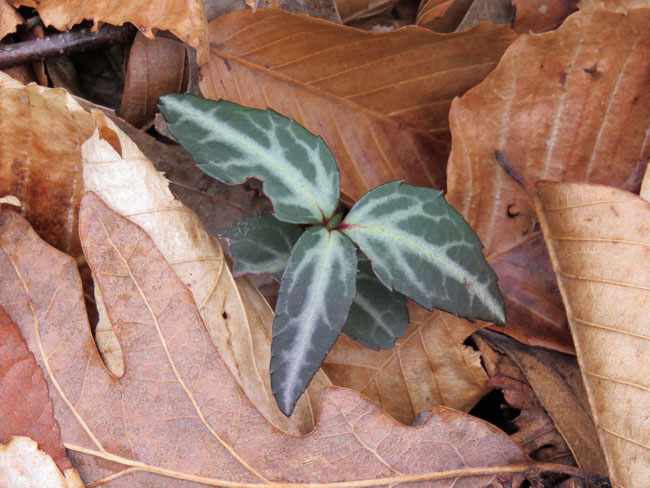
spotted wintergreen
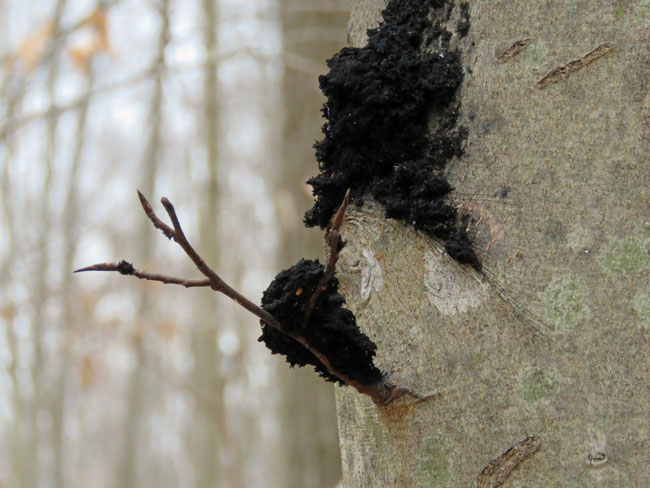
We were curious about this mysterious black stuff we saw on lots of the beech trees. Is it another symptom of beech bark disease?
The Leo Antonino Preserve is an unexpected tract of woods, wetland, rock outcroppings and erratics … The trail includes short sections of wide-open travel on packed earth and longer stretches of single-file trail that are rocky and rooty with elevation changes. The trail travels through areas of beech and oak and along vernal pools and active brooks. Erratics and upthrust sections of granite illustrate the geologic history of this section of Connecticut. Also illustrative of the history of this property, the yellow trail features the wreck of an old Chevy truck. The section of the yellow trail north of the Chevy is the most challenging with a scramble over a steep rocky ridge. ~ Avalonia Land Conservancy website
beech marcescence
very green mosses were everywhere
We made several crossings over a (or two?) brook. There were no bridges so we used the stepping stones, feeling grateful that we didn’t slip on the mosses!
another crossing
Tim left the trail, climbed the hill and then appeared from behind these erratics
yet another crossing
the wreck of an old Chevy truck
spotted wintergreen
a rusting metal circle hanging from a branch
ferns growing on top of a rock outcropping
lichen with moss
moss and lichen on different levels
sitting on top of a rocky ridge
American wintergreen
woodpecker work, I presume
???
Near the end of the trail we spotted these black lines on the path. I can’t help wondering if it’s the same black stuff we saw on the beeches…
I’ve been trying to be more selective and to include fewer pictures in my posts, but I had to make an exception for this one. When we started this hike I didn’t expect to take many pictures but it seemed like around every turn there was something interesting to notice. We’re looking forward to returning and trying the blue trail through these woods.
This was my first visit to this 140-acre park in our town, but Tim hiked here many years ago with one of his friends. The Pequots were the first people living here before the English colonized what is now the town of Groton and the village of Mystic.
The infamous Pequot Massacre occurred near here on May 26, 1637.
Capt. John Mason led English, Mohegan, and Narragansett warriors in an attack on the main fortified Pequot village on the site of modern-day Mystic, Connecticut. The Pequot were surprised but quickly mounted a spirited defense that almost led to an English defeat. Realizing that he could not defeat the Pequot in the close quarters of the palisade, Mason ordered their wigwams set afire; some 400 Pequot men, women, and children were burned alive or slaughtered when they tried to escape. ~ Encyclopædia Britannica
There have been archaeological digs conducted in this park, unearthing musket balls and arrowheads. But there are no memorials here to tell the terrible story.
trailhead
After the English took over, this land was cleared for farming, and today there are plenty of stone walls remaining from those days, before farms were abandoned and many people went out west. The woods came back. Now we have hiking trails, wildlife viewing and an abandoned farm pond.
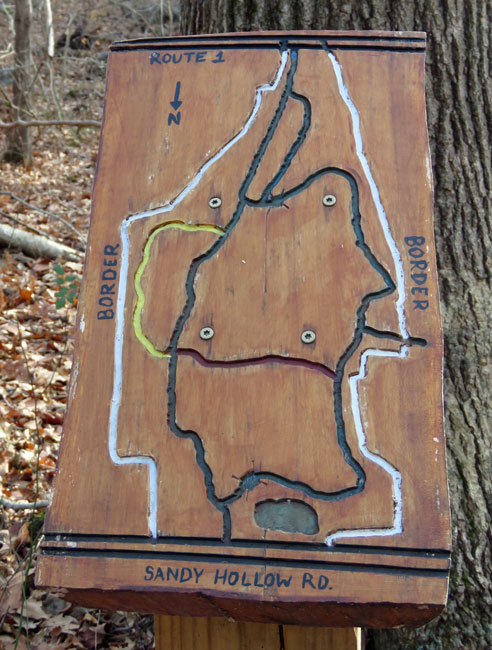
rough map carved in wood
the things this glacial erratic must have witnessed…
We gauge what we think is possible by what we know from experience, and our acceptance of scientific insights, in particular, is incremental, gained one experience at a time. ~ Bernd Heinrich (Winter World: The Ingenuity of Animal Survival)
lots of stone walls
beech marcescence
interesting composition
shelf mushroom overlooking farm pond
colonial stone slab bridge
princess pine, first sighting since January
hummocks in the man-made farm pond
pair of mallards
It was a partly cloudy day, very cold, 41°F/5°C, with a feels-like temperature of 33°F/1°C, due to a moderate wind from the northwest. We had a nice conversation about cameras with the man in the next picture. He was trying to get a picture of the mallards, too, and wondered about my telescopic lens. His mother has a camera like mine and he’s considering getting one, too.
rescued greyhound bundled up for the cold
the uneven terrain
birdhouse in the middle of the farm pond
another delightful princess pine encounter
As far as coronavirus pandemic statistics go, I’ve decided to chronicle Connecticut’s positivity rate to make my tracking simpler. Looks like we’re headed into yet another surge. On the day of this walk our positivity rate jumped to 6.32%, the highest it’s been since last January.