forty years of birding

5.23.21 ~ Avery Point ~ killdeer

Sunday we took a walk at Avery Point on a hot day, the temperature was way above average for this time of year, but we can park on campus without a permit on the weekends so we decided to give it a try. A nice sea breeze made it bearable.
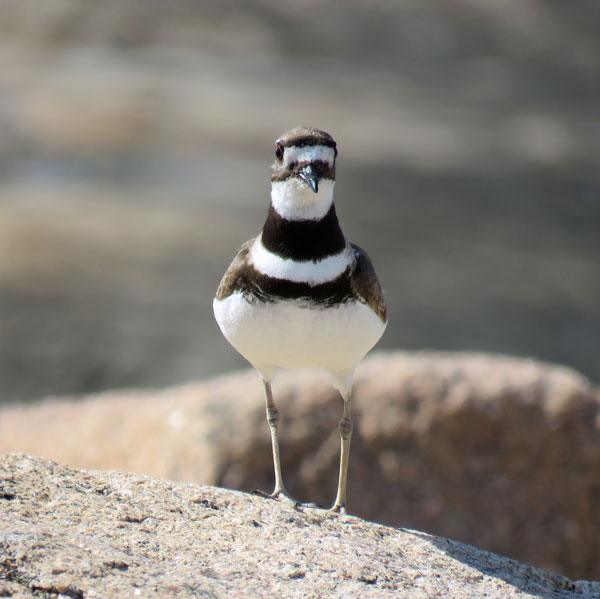
curious killdeer

A killdeer surprised me by standing very still, as curious about me as I was about him/her. Because the 30th anniversary of my mother’s death is coming up on Thursday, Mom and her love of birdwatching have been much on my mind. At home I decided to pull out her well-worn 1947 edition of A Field Guide to the Birds by Roger Tory Peterson, including her life list. She first saw a killdeer on March 17, 1951. She was 19 years old.

one last comment before scooting off

It looks like she started birding in earnest that year. There are a few birds marked with a check, which she probably remembered seeing before she started to keep a record. Lots of Florida birds were spotted in the 1960s, when I was a child and we made many trips down there to visit relatives. The last new bird she noted was a red-breasted nuthatch on December 20, 1989, 17 months before she died at the age of 59.

ants visiting a beach rose
I adore beach roses
beach rosebud
I only saw this one herring gull this day

Mom recorded 5 kinds of gulls: great black-backed, herring, California, ring-billed, and laughing.

not sure what this pretty bush is
still more new life late in the spring
bee collecting pollen
another beach rosebud
song sparrow

Mom recorded her song sparrow on March 20, 1951. This one was singing such a pretty song, the moment filled my heart with joy.

sunlit copper beech leaves
allium
allium?
daisy
salvia?

Funny thing was, I was hoping to find a Canada goose family with goslings, but we didn’t see any. People have been posting pictures of them in the beach’s Facebook group. Oh well. Encountering the killdeer was a welcome blessing, an even better experience. Another lesson in flexibility and living in the present moment. And it was nice that the killdeer led me to take a peek back into one of my mother’s life’s passions.

Mom first saw a mourning dove on May 23, 1951. A little synchronicity there. This walk was taken on May 23, 2021, seventy years later. Ever since my mother died I’ve been comforted by the mourning doves who keep coming to my garden and my balcony, as they keep reminding me of her presence and love.

at the same time

4.20.21 ~ red maple seeds
Connecticut College Arboretum, New London, Connecticut

Yesterday we took an amazing walk at the arboretum! A long one, for an hour and a half. We concentrated on the wildflower garden and the bog, both bubbling with the delightful signs of springtime.

the world’s emergence

The person who practices this exercise of concentration sees the universe with new eyes, as if he were seeing it for the first and the last time. In his enjoyment of the present, he discovers the splendor and mystery of existence and of the world’s emergence; at the same time, he achieves serenity by experiencing how relative are the things which provoke anxiety and worry.
~ Pierre Hadot
(What is Ancient Philosophy?)

skyscape
red maple

Edgerton & Stengel Memorial Wildflower Garden

striped maple
Canadian white violet
yellow trout lily
Virginia bluebells before opening
bloodroot

Can words describe the fragrance of the very breath of spring — that delicious commingling of the perfume of arbutus, the odor of pines, and the snow-soaked soil just warming into life?
~ Neltje Blanchan
(Wild Flowers: An Aid to Knowledge of Our Wild Flowers & Their Insect Visitors)

Virginia bluebells

Glenn Dreyer Bog

moss covered hunk of something
underwater art
tadpoles!
Glenn Dreyer Bog
tadpole and tadpole shadow
red maple
tree scars
peaceful pond
Canada geese

In the light shed by the best science and scientists, everything is fascinating, and the more so the more that is known of its reality. To science, not even the bark of a tree or a drop of pond water is dull or a handful of dirt banal. They all arouse awe and wonder.
~ Jane Jacobs
(Dark Age Ahead)

points of viewing

3.22.21 ~ looking towards Tyler House at Eastern Point Beach
from Griswold Point

There is another “point” north of the beach at Eastern Point, a little up the Thames River, called Griswold Point by the locals, even though I cannot seem to find that name on a map. The grand luxury Griswold Hotel was once located here (1906-1967); part of a golf course now occupies the space. There is a small nameless park area and a street between the golf course and the river. I didn’t know we were allowed to park on the street but Tim said we are so we decided to visit the spot on Monday.

New London Ledge Light, with telephoto lens from Griswold Point

It was interesting seeing these two lighthouses from a different point of perspective.

New London Harbor Light

Tim drew my attention to the river where a couple of unfamiliar ducks were sitting on a rock. A wave from a ferry came along and washed them off the rock and we watched them swim away, their dignity intact.

American wigeons

Nearby we spotted some brants swimming…

brants

And then, much to my delight, a little song sparrow decided to pose on the branch of a bush. He might be part of the flock that was living down by the beach because when I got to there later I found that their thicket had been removed and they were gone. 🙁

song sparrow

And then Tim spied a tall ship on the horizon. He guessed (correctly) it was the USCGC Eagle returning to port.

USCGC Eagle from Griswold Point

So we hopped back in the car and headed for Eastern Point to watch it come in. When we got there we could hear the sailors’ voices across the water even though they were so far away. The water was very calm.

USCGC Eagle from Eastern Point

While we waited for the tall ship to come closer we took a walk on the sand…

seaweed assortment
shell and sand grains

When we came back to the rocks and Tyler House we found a crow waiting, too.

American crow
US Coast Guard Eagle
(training cutter for future officers of the United States Coast Guard)
New London Ledge Light surrounded by calm water patterns
Race Rock Light, eight miles away

And this time coming home, some crocuses waiting for me in my garden. 💙

first crocuses in my garden

dunescape

3.12.21 ~ gull on breakwater
Napatree Point Conservation Area, Watch Hill, Rhode Island

My yearning for Cape Cod had been becoming more and more intense in recent weeks so on Friday we decided to visit the next best place, Napatree Point, just over the state line in Rhode Island, the Ocean State. Another lovely warm and sunny day to enjoy before the cold weather returned for the weekend.

Atlantic Ocean

We could hear the waves long before we climbed over the dunes. The smell of the refreshing salt air beckoned. Along the way there was plenty of evidence of storms shifting the sands of the dunes over the winter.

“Dune Restoration in Progress”
remnants of a sand fence
“Ticks May Be Found in This Area”
imagine the force of the wind and water…
Napatree Point is a slender, 1.5 mile long peninsula
peaceful ocean, this day
dunescape
dune grass
shells
Watch Hill Lighthouse in the distance
spectacular sky
seed pod
seed pod
buds of a beach rose

It was uplifting communing with the dunes and the sea. Much needed after a long, cold February! And at home, a snowdrop waiting for me in my garden. 💙

snowdrop

even the smallest thing

2.19.21 ~ white-throated sparrow, Birch Plain Creek

One can only hide from the cold for so long. One’s mind needs to be outdoors! One’s spirit needs simple things. It snowed most of the day on Thursday and Friday and when I woke up at 4 a.m. Saturday morning there were still flurries dancing around. We went for a walk in the scattered snow showers on Friday, with about five inches of the white stuff on the ground. Not wanting to drive anywhere, we walked in the woods and along the creek behind our condo complex.

I spotted a new bird, for me, a white-throated sparrow! She was not cooperating about posing very much but I was happy to get the above picture. One musn’t be greedy. I wonder what she was eating.

left over from a city-wide Valentine’s Day scavenger hunt
mourning dove

A mourning dove landed on a branch and eyed me. I thanked her for letting me see the coloring under her tail. Another new thing for me to see. And then she knocked some snow off the branch — yes dear little dove, I did see you do that. 😉

mourning dove knocking snow off the branch
waiting for spring

The creek was mostly frozen over. Tim spotted three gulls out on the ice. Two waiting for an opportunity and one devouring a fish. One always wonders who stole it from who…

great black-backed gull, first winter
it looks cold out there on the ice
winter survival

How surely gravity’s law,
strong as an ocean current,
takes hold of even the smallest thing
and pulls it toward the heart of the world.

Each thing —
each stone, blossom, child —
is held in place. …

This is what the things can teach us:
to fall,
patiently to trust our heaviness.
Even a bird has to do that
before he can fly.

~ Rainer Maria Rilke
(Rilke’s Book of Hours: Love Poems to God)

somebody’s tracks
Birch Plain Creek

My mood improved 100% by the time we returned home. Pretty flurries just continued floating through the sky all morning and afternoon, until dark, still there every time I looked up from my book. I have finished reading The Bear and the Nightingale by Katherine Arden and have started on The Girl in the Tower, the second book in the Winternight trilogy. Perfect books for winter.

Birch Plain Creek

high tide with storm surge

2.1.21 ~ my river birch during the snowstorm
from my kitchen window

So, on Monday we got 10 inches of snow before it turned to sleet. Snow is fun, sleet is not. On Tuesday, Groundhog Day, we drove down to the beach around noon but didn’t stay too long. The gale was lingering with a storm surge at high tide and the wind was still howling. There were no shadows, therefore, according to tradition, spring will come early. Yay!

2.2.21 ~ young great black-backed gull, Eastern Point

It turned out to be a nice day for photographing gulls. 🙂 They love to pose.

another young great black-backed gull
which side is better?
a friendly ring-billed gull came over when I asked him to
he turned to listen to me talking to him
very high tide ~ waves past the lifeguard chairs
churning sea
storm surge almost higher than the breakwater

After marveling at the high water we drove up the road along the Thames River.

flooded marsh across the street from the beach
brant in Thames River
a pair of mallards very intent on something tasty in the flooded grass
they never lifted their heads and my fingers were freezing
another mallard landed nearby in the snow to investigate

And then we left, shivering but still happy to have gotten out for a short while! I didn’t see the song sparrows but then again, I didn’t wade through the soggy grass to get to their thicket. I hope they’re all right. The water was almost up to their home. It’s amazing how birds survive the storms.

winter-patience

1.13.21 ~ Stoddard Hill State Park
Ledyard, Connecticut

Several weeks after our first visit to this state park we returned to hike up the hill to the lookout, 183 feet (56 meters) above the river. The leaf-covered path started behind the cemetery and was much more steep than we had anticipated.

looking towards the Thames River from behind Stoddard Cemetery

It wasn’t long before I covered the camera lens and grabbed two strong walking sticks to steady myself. Tim already had his walking stick and was more steady on his feet, but had to stop frequently to catch his breath. I was starting to question the wisdom of embarking on this expedition! Especially when we lost the trail and decided to just keep going up…

several kinds of moss and lichen on a rotting log

When things leveled off a bit I got a few pictures…

mushroom
princess pine trying to poke through the layers of leaves

Near the top we turned around near this ledge and saw the cemetery way down below…

Stoddard Cemetery from high above

At last we could see an opening in the woods and views of the river, trees and railroad tracks below. Tim said it was a good thing we came in the winter because the leaves on the trees would have blocked these lovely scenes. Keep in mind, under these ridges is that jumble of glacial erratics pictured in the last post. We didn’t go close enough to the edge to peek down there.

even way up here there were a few dead fish

Only with winter-patience can we bring
The deep-desired, long-awaited spring.

~ Anne Morrow Lindbergh
(The Unicorn & Other Poems)

We found the trail again and managed to follow it all the way back down to the cemetery. I’m pleased to report that neither of us fell! I slipped a couple of feet once but my sticks saved me. 🙂 That’s probably enough of steep climbs for us!

hairy woodpecker, telephoto lens
same hairy woodpecker
mallards on Stoddard Cove, also telephoto lens
thin ice on Stoddard Cove

It was nice to finally stand on level ground and take a couple of bird pictures. Phew!

a bit nippy

1.7.21 ~ song sparrow, Eastern Point

The song sparrow, who knows how brief and lovely life is, says, “Sweet, sweet, sweet interlude; sweet, sweet, sweet interlude.
~ E. B. White
(Charlotte’s Web)

1.7.21 ~ brants in Thames River estuary

Thursday’s afternoon walk was a bit nippy. (We thought it might be slightly warmer than our usual morning walk. It was, but still, my fingers froze. Maybe two layers of gloves in the future… Maybe stop trying to take so many pictures…) I counted five song sparrows flitting about near the thicket and sea wall. I left them a few seeds.

And we saw a huge flock of brants on the lawn. Suddenly they took off en masse to fly a short distance and alight on the river. (Attemped in-flight photos were all blurry.) If you want to hear the sound they made while flying there’s an audio clip at the bottom right side of this webpage: brant sound. It’s very different than the honking sounds Canada geese make.

Maybe they’re here for the eelgrass and will then move on to greener “pastures.” I can only imagine how much of it such a huge flock consumes in a few days.

1.7.21 ~ Canada geese in Beach Pond

Geese are friends with no one, they badmouth everybody and everything. But they are companionable once you get used to their ingratitude and false accusations.
~ E. B. White
(Charlotte’s Web)

first winter

12.24.20 ~ Eastern Point ~ great black-backed gull, first winter

This gull certainly knows how to fish and feed himself. His parents prepared him well for his first winter here in New England. We first started seeing great black-backed gulls here in 2012 and it seems they are here to stay. Their huge size (length 25-31″/64-79 cm), compared to other kinds of gulls, always impresses me.

This very large, black-backed, pink-legged gull is the largest gull in the world, and males in particular are massive.
~ Steve N. G. Howell & Jon Dunn
(Gulls of the Americas)

It takes four years for these gulls to finally get their adult plumage. This one seems to be off to a good start. They can live for over twenty years.