the intelligence of a place

3.30.24 ~ ‘old blush’ rose
North Carolina Botanical Garden

It’s always a pleasure to be greeted by the roses dangling from their arbor each time we visit the botanical garden. It never gets old! Like sunrises and sunsets, I suppose. A steady presence. But we were on a new mission this day to locate a Virginia dwarf trillium, another tiny ephemeral we heard was blooming. Along the way we saw…

Spanish lavender
hermit thrush

This (below) was the only undamaged dwarf trillium we could find, surrounded by other kinds of plants. We had torrential rains for a couple of days and I think they did a number on the tiny trilliums. But I’m grateful we got a chance to see this one. It is much smaller than all the other regular size trilliums we’ve been seeing this spring.

Virginia dwarf trillium
spreading Jacob’s ladder
white-throated sparrow

Only by living for many moons in one region, my peripheral senses tracking seasonal changes in the local plants while the scents of the soil steadily seep in through my pores — only over time can the intelligence of a place lay claim upon my person. Slowly, as the seasonal round repeats itself again and again, the lilt and melody of the local songbirds becomes an expectation within my ears, and so the mind I’ve carried within me settles into the wider mind that enfolds me.
~ David Abram
(Becoming Animal: An Earthly Cosmology)

yellow trillium
twisted trillium
pine warbler
sweet shrub aka Carolina allspice
great white trillium (?)
tufted titmouse
red chokeberry
squirrel going out on a limb to reach maple seeds
what a mess he made discarding the “helicopters”
carpenter bee
(thanks to Eliza for the identification)

As we were making our way back to the parking lot this giant bee (above) was hovering over the walkway, blocking our path. Well, if it was just going to stay there I might as well get a picture of it. I don’t know if these creatures are unique to this area but sometimes they hover outside our windows and crash into them repeatedly. It sounds like someone is throwing pebbles at the window.

So we’ve lived here for ten moons I think, not very many so far, but our senses are slowly getting familiar with the seasonal changes.

early spring in the arboretum

3.17.24 ~ pineland phlox
Coker Arboretum, Chapel Hill, North Carolina

This post is my contribution to Karma’s Signs of Spring Photo Hunt. I don’t have a prime lens, but the photos, except for the birds, were taken at about the same focal length with my zoom lens. (There was a lot of squatting involved to get the pictures.) Visit Karma’s post here if you’d like to participate.

stinking hellebore

It was spring break at UNC and we learned that we could easily find a parking space on campus when the students are out of town. And that meant we could finally visit the lovely Coker Arboretum, 5 wooded acres in the middle of a college campus. I came home with more than 300 photographs! What follows is a small sample of the birds and blooms we saw. Some of the plants were from other parts of the world.

Alabama snow-wreath
magnolia
spring starflower (South America)
Chinese redbud (China)
spring snowflake (Europe)
golden ragwort
Japanese camellia
spike winter-hazel (Japan)
hermit thrush
white-throated sparrow
‘hino-degeri’ azalea
‘snow’ azalea
Carolina wren
American robin
Spanish bluebell (Iberian Peninsula)
flowering quince
Carolina silverbell
cut-leaf lilac

I was especially attracted to the tiny South American spring starflowers which carpeted some of the garden plots. Something about those little purple lines on the petals. And the European spring snowflakes captivated me. They were a little bigger than our snowdrops. When I got home I learned they were native to southern Europe, all the way east to Ukraine, so I wondered if any of my ancestors had them in their gardens to welcome spring over there.

a day to remember

3.27.23 ~ Harkness Memorial State Park

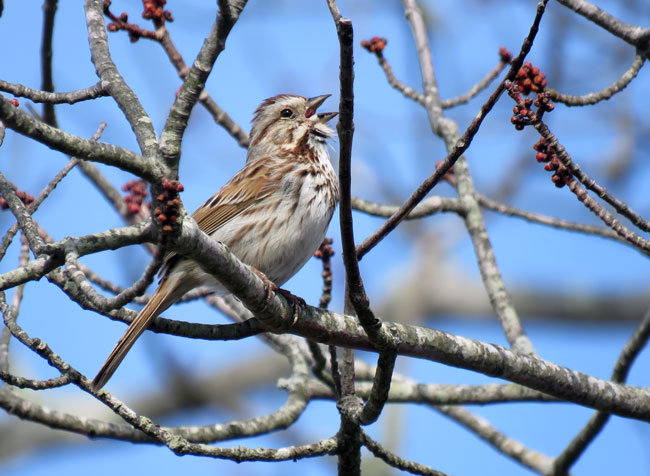
Please bear with me as I post more photo memories to take with me when we move! Harkness Memorial State Park is one of my favorite places, year-round for the waterbirds and in the summer for the flower gardens. On this walk we were immediately greeted by a sweetly singing song sparrow, who flew from branch to branch, teasing me. But I did get a few pictures of him!

song sparrow singing his heart out ~ it’s spring!
song sparrow
wading herring gull
American Black Duck, #76
(thanks to Donna for the identification)

American Black Duck Anas rubripes: Common coastal migrant and wintering species. In summer, an uncommon breeding species in freshwater and brackish habitats, especially coastal marshes; inland nesting occurs in freshwater marshes, densely forested swamps, and beaver ponds, mainly in central and western Connecticut.
~ Frank Gallo
(Birding in Connecticut)

The American Black Duck hides in plain sight in shallow wetlands of eastern North America. They often flock with the ubiquitous Mallard, where they look quite similar to female Mallards. But take a second look through a group of brown ducks to notice the dark chocolate-brown flanks, pale grayish face, and olive-yellow bill of an American Black Duck. Numbers of this shy but common duck declined sharply in the mid-twentieth century. Hunting restrictions have helped to stabilize their numbers, although habitat loss remains a problem.
~ All About Birds webpage

dabbling and dripping
mute swan
no mate in sight
out of the water
osprey, waiting for a mate to return?
I heard this Carolina wren singing very loudly,
but it took me a long time to locate it!
lovely snowdrops
Race Rock Lighthouse, 12 miles away on the horizon
Connecticut’s beautiful rocky coastline
very blue sky to the north
flock of brants swimming in the sound
brant
wrack line art
sand art

Today was a beautiful, calm, spring day. No wind! A woman was there trying to fly a kite, which is possible there more often than not, but she had to give up. The temperature was 52°F (11°C) so I had my first walk of the year with no thermal leggings, wearing my spring hoodie. 🙂 I am going to miss living by the sea very much.

moments of wonder and joy

1.7.23 ~ song sparrow at Moore Woodlands

Resuming our walks! When we arrived at Moore Woodlands the birds were singing and it sounded like spring. It was 44°F/7°C and cloudy on this warm-for-January day. As we started walking around the meadow a song sparrow came down to the bushes and started singing for us. This made my whole day!

standing out in the meadow
lone tree in the meadow
beech marcescence

It is not enough to weep for our lost landscapes; we have to put our hands in the earth to make ourselves whole again. Even a wounded world is feeding us. Even a wounded world holds us, giving us moments of wonder and joy. I choose joy over despair. Not because I have my head in the sand, but because joy is what the earth gives me daily and I must return the gift.
~ Robin Wall Kimmerer
(Braiding Sweetgrass: Indigenous Wisdom, Scientific Knowledge & The Teachings of Plants)

wondering what those rusty maroon blobs are growing with the reindeer moss
~ amber jelly roll mushrooms ~
(thanks to Eliza for the identification)

In the woods we found a great many eastern red cedar trees that must have come down in a storm. Where they fell across the trail they had been cut and moved off to the side. It was interesting seeing the redness of the freshly cut wood.

We also saw a lot of English ivy growing on the ground and climbing some of the trees. I did some research when I got home and learned that the ivy is invasive and greatly weakens the trees they climb, making them more likely to fall during strong winds. It looks like the Avalonia Land Conservancy has been working to remove the ivy from this patch of woodland. We also saw quite a few eastern white pine saplings.

It also looks like the land conservancy is starting to identify the trees with little tags! I’d like to get more familiar with our local trees and welcome this new aid. This was a lovely first walk for the new year. 🙂

in the fields of the commonplace

12.9.22 ~ Poquonnock River Walkway

It was time to dust off the camera and resume taking our walks again. The big project is, for all intents and purposes, finally completed. But, I haven’t figured out how to write about it yet, so that long story will have to wait until after the holidays. Now to prepare for the coming visit of our darling grandchildren!

I added a layer of thermal leggings under my jeans for the first time this season and then we enjoyed the winter scenery along the Poquonnock River Walkway. We might be getting a coating of snow this afternoon. I love the cloudy light before snowstorms.

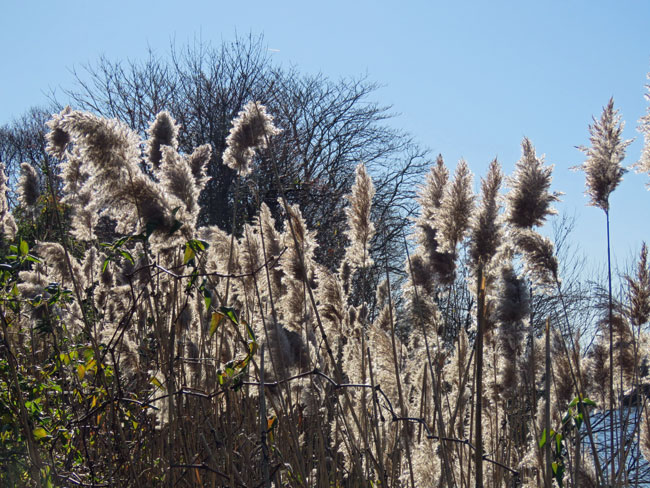
But the winter sun was shining brightly for the day of our walk, illuminating the tops of the reeds in a magical way.

Let us dig our furrow in the fields of the commonplace … and leave to others, more favoured by fortune, the job of explaining the world’s mechanism, if the spirit moves them.
~ Jean-Henri Fabre
(The Life of the Fly: With Which are Interspersed Some Chapters of Autobiography)

We came across a large flock of house sparrows flitting around in the bushes along the boardwalk — how commonplace can it get? But a couple of them actually stayed put long enough to get their portraits taken.

It felt very good getting out of the house again and enjoying the ordinary, simple things the natural world has to offer.

flora by the sea

10.10.22 ~ Cognitive Garden at Avery Point

On Indigenous Peoples’ Day my good friend Janet and I took a long afternoon walk from Eastern Point to Avery Point and back again, passing by Beach Pond both ways. The weather was picture perfect, if a bit on the breezy side.

After admiring the views of Long Island Sound and identifying the various islands and lighthouses we could see on a clear day, we found the “Cognitive Garden” on the Avery Point campus. There was still a lot of interest to see there in the middle of autumn. Textures and colors.

Cognition means to acquire knowledge through the senses, experience, and thought. A cognitive garden encourages learning through these three processes while exposing people to nature. While the benefits of nature extend to all ages, young children learn primarily through their senses and a multitude of studies have demonstrated a correlation between sensory stimulation and brain development.
~ University of Connecticut, Avery Point Campus website

The naturalist is a civilized hunter. He goes goes alone into a field or woodland and closes his mind to everything but that time and place, so that life around him presses in on all the senses and small details grow in significance. He begins the scanning search for which cognition was engineered. His mind becomes unfocused, it focuses on everything, no longer directed toward any ordinary task or social pleasantry.
~ E. O. Wilson
(Biophilia)

black-eyed Susan

I wish I could include the smell of a patch of thyme for you, dear readers. What an amazing scent filled the air!

thyme ~ it smelled wonderful!
a bee enjoying the smell, too

On the way back I was happy to see that Beach Pond was full of water again, although we were still in a moderate drought that day. I suspect Thursday’s torrential rains may have moved us up into the abnormally dry category. No waterbirds around but still some flowers blooming, and others spent.

asters at Beach Pond
cattails with fluff

So come to the pond,
or the river of your imagination,
or the harbor of your longing,
and put your lips to the world.
And live
your life.

~ Mary Oliver
(Red Bird: Poems)

the pond is full of water and the breeze was making little ripples
juvenile song sparrow
backside of a lingering swamp rose mallow and orbs
swamp rose mallow bud and orbs

It felt so good sauntering along and catching up with a friend!!!

meadow, woods, old orchard

9.30.22 ~ Coogan Farm Nature & Heritage Center

It felt so good getting out for a long walk in the woods on a cool, crisp autumn day! First we enjoyed the meadows at the entrance to Coogan Farm.

milkweed pods
abundant goldenrod blooming everywhere
bee and asters
can you find the bee?
a stump that was growing out of the crack in a huge boulder

Following a path past the Giving Garden we came to the Gallup Orchard Trail, which winds through the woods before arriving at a forgotten orchard that was recently discovered and is being studied and restored.

a wolf tree welcoming us to the Gallup Orchard Trail,
a relic from farms of the past when trees along the edges of open fields
could spread their branches without competition from other trees
leaf, berries and orbs
ducked under a broken tree
marking the end of the woods and entrance to the orchard

Dating back to the original 1654 Gallup homestead and actively farmed by the Greenman brothers during the age of shipbuilding in the 1800s to feed their shipworkers at what is now Mystic Seaport Museum, the orchard contains clues that will help us uncover the history and heritage of the land.
~ Anna Sawin
(“Apples and Pears, Oh My!” ~ Denison Pequotsepos Nature Center blog post, March 9, 2020)

pear on tree
apple on tree
fall color in the distance

The orchard is on a hill. We entered at the top of the hill and when we found our way down to the bottom we found this sign. The bottom entrance is off the Stillman Mansion Trail. We followed that trail back to the parking lot and encountered a cute little song sparrow, who wasn’t singing, only staring at us apprehensively.

song sparrow

Life starts all over again when it gets crisp in the fall.
~ F. Scott Fitzgerald
(The Great Gatsby)

American burnweed ~ pilewort (thanks to Eliza for the identification)

I hope we get lots of walks in this autumn! 🍂 🍁 🍂

copper beech healing

7.4.22 ~ Avery Point

If we keep having these lovely weather days I might have to change my negative feelings about the summer season. Returning to Avery Point we again found a song sparrow singing at the top of the beach rose bushes. I wonder if it’s the same one we met a month ago. He was in the same spot.

song sparrow still king of his beach rosebushes

The bushes were full of rose hips but I think there will be another bloom or two left in the season.

beach rose hip and thorns
fading
beach rosebud ~ there are still more to come
there were still a few in full bloom
Avery Point Light

Look who was very busy digging bugs out of the lawn…

northern mockingbird

I lingered under this immense copper beech tree and held my hand on it, soaking up some healing energy. (It’s trunk was way too big to hug!) Looking up into its branches was a transcendent experience.

We come into being in and through the Earth. Simply put, we are Earthlings. The Earth is our origin, our nourishment, our educator, our healer, our fulfillment. At its core, even our spirituality is Earth derived. The human and the Earth are totally implicated, each in the other. If there is no spirituality in the Earth, then there is no spirituality in ourselves.
~ Thomas Berry
(The Sacred Universe)

copper beech

Not sure what kind of tree this is (below) but the slash in its bark was striking. I wonder how long it’s been there and if it grew with the tree…

What would our lives be without trees? Bleak and inhospitable, I’d say. What a blessing to have their gifts to us and the other creatures in our summer world.

piping plovers

6.29.22 ~ Harkness Memorial State Park

Another gorgeous day for a walk, this time through the meadow and nature preserve at Harkness Memorial State Park.

All the birds were quite far away and the distance was a bit too much for my zoom lens to handle.

song sparrow high up top of a tree
song sparrow and cobweb

When we got to the bird viewing blind at Goshen Cove I was delighted to see and to add a new lifer to my list, even though the dozen or so piping plovers were so tiny and at a good distance…

Piping Plover, #72

Piping Plover Charadrius melodus: Endangered, rare to locally uncommon migrant; breeds on sandy beaches with limited human disturbance, mid-March to mid-November.
~ Frank Gallo
(Birding in Connecticut)

Piping Plovers are sandy grayish brown birds with white underparts and a narrow, often broken collar. They have yellowish orange legs in all seasons. In the breeding season, they have an orange bill with a black tip, a black collar, and a black line on the forehead. In the nonbreeding season, the bill is black and the collar fades to gray and doesn’t go all the way around the breast.
~ All About Birds webpage

I was so captivated by the piping plovers I almost missed this willet who came strolling by, much closer to the blind. As if offended, he turned and walked away from me.

willet

Three women came into the blind and were very excited by some activity on the osprey nest. They didn’t notice the piping plovers at all. I finally looked at the ospreys, also too far away for my camera…

ospreys

After all that stimulation we left the blind and continued along through the lovely meadow. There was a touch of humidity and although it wasn’t too much for me Tim was starting to feel it. This may be our last extended walk for a while. It’s supposed to get hot and humid tomorrow.

a nice park setting between the meadow and Long Island Sound
Long Island Sound

While we were taking in a view of Long Island Sound we heard the unmistakable call of approaching American oystercatchers. Three of them finally came into view flying over the sound, parallel to the the shoreline. We followed them with our eyes until the they vanished on the horizon. I hope we’ll get to have some nesting on our beach this summer. We saw them about this time last year.