midwinter in self-quarantine

12.21.20 ~ 7:11 am, foggy winter solstice sunrise

After nine months in self-quarantine life still seems pretty bizarre. The coronavirus pandemic still rages and is getting worse with every day. Our fervent hope is that getting everyone vaccinated will turn things around sooner than later. Two of our elderly relatives-in-law have caught it, one is still fighting for his life in the hospital and the other is still sick and isolating at home. Some of Tim’s friends have lost loved ones. These are truly dark days.

Since I took a sunset picture for the summer solstice in June I decided to take a sunrise picture for the winter one. But we had fog and clouds on solstice morning, not even a hint of daybreak in the sky. There was a travel advisory for black ice on the roads so we stayed home and I took the picture from an upstairs window.

We had tried to take a walk on Saturday but found a sheet of ice on top of the snow making it too hazardous to continue. So instead of attempting another trek out on Monday I put Grandfather Frost out on our balcony, hoping to catch him casting the longest shadow of the year at noon. At first there was no sun and no shadow but by some miracle the bright star came out from the clouds right at solar noon for just a quick minute! I took the picture and then it disappeared again. (If I had known where the railing shadows would fall I would have located him standing fully in the sunshine!)

12.21.20 ~ 11:46 am, solar noon
longest shadow of the year!

A year indoors is a journey along a paper calendar; a year in outer nature is the accomplishment of a tremendous ritual. To share in it, one must have a knowledge of the pilgrimages of the sun, and something of that natural sense of him and feeling for him which made even the most primitive people mark the summer limits of his advance and the last December ebb of his decline. All these autumn weeks I have watched the great disk going south along the horizon of moorlands beyond the marsh, now sinking behind this field, now behind this leafless tree, now behind this sedgy hillock dappled with thin snow. We lose a great deal, I think, when we lose this sense and feeling for the sun. When all has been said, the adventure of the sun is the great natural drama by which we live, and not to have joy in it and awe of it, not to share in it, is to close a dull door on nature’s sustaining and poetic spirit.
~ Henry Beston
(The Outermost House: A Year of Life on the Great Beach of Cape Cod)

12.21.20 ~ yule tree

We kept trying to get a decent picture of our lovely “snowball and icicle” tree but our cameras refused to focus — at least you can get a vague impression of it from this one. I suspect the camera doesn’t know what to do with the little lights and glass reflections. Then again, I’ve never mastered the art of indoor photography. Outdoor light is my friend. I tried to get a few close-ups of ornaments with mixed results. The best ones follow….

May your holidays be merry and bright and full of blessings and gratitude. As the light returns and as our days grow longer may the coming year sparkle with hope, love and peace. 🌲

longest night of the year

“Winter Night in Rondane” by Harald Sohlberg

🕯️

Keep me safe and hold me tight 
Let the candle burn all night 
Tomorrow welcome back the light 
It was longest night of the year 

We press our faces to the glass 
And see our little lives go past 
Wave to shadows that we cast 
On the longest night of the year 

Make a vow when Solstice comes 
To find the Light in everyone 
Keep the faith and bang the drum 
On the longest night of the year 

~ Mary Chapin Carpenter
♫ (Longest Night of the Year) ♫

holiday lights

11.26.20 ~ Holiday Lights Spectacular
Olde Mistick Village, Mystic, Connecticut

This pandemic Thanksgiving felt so strange with just the two of us, to say the least. We had takeout turkey, worked on a jigsaw puzzle, listened to music, communicated with faraway relatives, and when it got dark and stopped raining, went to see some holiday lights at a large outdoor shopping village.

It was very pretty, although I don’t think they had all their lights up yet. There were a few families there with small children. Everyone was wearing masks and stayed quite far apart. (I’ve started wearing two masks when I go outside these days. I still won’t go inside of a building.)

After we were there a while they started playing music which was very festive but it seemed so bizarre to have to exchange muffled Happy Thanksgiving greetings from behind our masks and from a distance.

I wonder what the holiday shopping season will be like. We’ll be ordering a couple of gifts for our grandchildren from local businesses in their area so our daughter can pick them up curbside and wrap them for us.

It will be interesting to see on the news what happens for Black Friday… (Something I frown upon and have never participated in…) I hope common sense will prevail somehow.

Irish Eyes, one of our favorite stores
Bestemors, my favorite store
nisse in the store window
lights in the upstairs window
troll in another window
lights dangling from large tree

Heading out for a walk in the woods today. We decided we do want a solstice tree this year, but will wait until the middle of next week to visit the local tree farm, so as to avoid the weekend crowd. We are determined to make the best of things!

circling around the kettle

11.4.20 ~ Kettle Hole Trail
Ledyard, Connecticut

Kettles form when blocks of ice are broken off of the glacier and then buried in drift. When the retreating glacier melts, so does the block of ice, leaving a depression. Kettles can be very small and hard to find if they are obscured by foliage, and if the water remained in the hole, they can become lakes.
~ Jessica Cobb
(Connecticut’s Landscape Is the Story of Glaciers website)

a stone wall surrounded most of the kettle,
it’s hard to see how far the land drops down beyond the wall

While trying to learn more about glacial erratics online I discovered kettles, and learned that we had one nearby. And so Tim & I were off to have a look at Kettle Hole in Ledyard. A loop trail circles along the perimeter. Well, it was very large and easy to find, even though it was obscured by foliage, and was not filled with water. Unfortunately, this kettle was not easy to capture in a photograph, its depth (perhaps about 50′ – 15m) just didn’t show up in a flat picture. Sigh.

Tim thought the drop might be more visible from this angle
this rock looked like it had started to tumble into the kettle

All the same, we had a very pleasant walk on a lovely autumn day. And enjoyed photographing other things. We’ve had some rain here and there so our drought level has dropped to moderate, so we’re headed in the right direction.

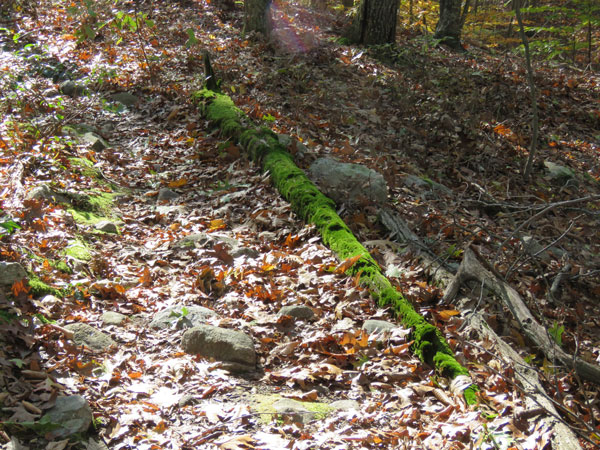
rotting log covered with moss
not sure what to make of this,
it looked like a miniature fern growing out of and lying on top of the moss

All through autumn we hear a double voice: one says everything is ripe; the other says everything is dying. The paradox is exquisite.
~ Gretel Ehrlich
(The Solace of Open Spaces: Essays)

acorns and oak leaves on moss
fading fall colors
princess pines ♡ little fairy forests in my mind
spotting these evokes sweet memories from my childhood

The green branchlets and stems of princess pines stay fresh-looking all winter, and they stand out prominently on the dry browns of a forest floor. Being evergreen like that may have contributed to the name, even though princess pines do not make pine cones. People often collect the tough, pliable plants and make Christmas wreaths and lush table arrangements out of them. They last a long time that way, despite the dryness of life on bare walls and tabletops. All you have to do is soak them in water for an hour or so to revive them. Although princess pines do a fine job of evoking holiday spirit, I do not want to encourage you to go out and collect great heaps of them every year. So many people are doing it already that some of these plants are in danger of being wiped out.
~ Curt Stager
(Field Notes from the Northern Forest)

the first touch of winter

“At the First Touch of Winter, Summer Fades Away”
by Valentine Cameron Prinsep

The days move more swiftly now, too, with late dawns and early dusks. The days march toward the winter solstice like a winter farmhand with the wind at his back. And the long nights become the sleep of the earth itself, the rest, the waiting. The fox barks in the night, in the glitter of winter starlight. The deer shelter in the hemlock thickets on the mountain. The woodchuck sleeps, breathing only once in five minutes. And that hurrying wind whistles in the naked maples. November is at hand. This is the hurrying, impatient wind of winter that I hear in the night.
~ Hal Borland
(Hal Borland’s Book of Days)

shades of scarlet, saffron, and russet

10.24.20 ~ Connecticut College Arboretum
New London, Connecticut

Autumn that year painted the countryside in vivid shades of scarlet, saffron, and russet, and the days were clear and crisp under the harvest skies.
~ Sharon Kay Penman
(Time & Chance)

a copper and butterscotch harvest

The Connecticut College Arboretum Facebook page invited us over to check out the fall colors in all their glory. We were not disappointed! I had been reluctant to visit because New London was a designated coronavirus “red alert town” but now that Groton is, too, we decided we didn’t have much to lose.

black oak

One very nice feature of an arboretum is that many of the trees have identification tags on them.

fringe tree

In June, the above fringe tree has spectacular white fringe-like blossoms. (Janet may remember them!) To see a picture scroll down to the last few pictures on this post: late spring in the woods.

sweetgum
tulip tree
a maple (no tag)

But autumn leaves have another than their natural history — like autumn sunshine they have merits that concern the rambler, who cares not a fig for their botanical significance — what may be called their sentimental history.
~ Charles Conrad Abbott
(Days Out of Doors)

russet majesty
grove on top of a hill
evidence of the severe drought in the pond
blueberry growing out of glacial erratic in the middle of the pond
glacial erratic framed in saffron
(probably) ruby slippers hydrangea spent blossoms
(probably) ruby slippers hydrangea leaves
thanks to Melissa for help with identification
we got a little bit lost in there
heritage river birch

This might be my favorite tree in the whole arboretum. It is so tall there is no way I could get a picture of all of it. The texture of the bark is a pleasure to behold. The trunk splits in two and the view between them is spectacular. I love its energy. I have a dwarf river birch in my garden. It’s not nearly as tall.

looking up
looking out over the arboretum

We had walked for over an hour and I came home finally feeling satisfied that I hadn’t missed anything this autumn had to offer. 🙂

mostly dull colors

10.23.20 ~ Denison Pequotsepos Nature Center
Mystic, Connecticut

It’s been a challenge finding red leaves this autumn, while dull yellows are everywhere. Looks like our nights haven’t been chilly enough to encourage a brighter display this year. Perhaps the drought is a factor, too. But I continue the search. On Friday we walked on the Denison Farm Trail at the Denison Pequotsepos Nature Center.

amber

To get a really good, colorful display, you want to have chilly nights alongside sunny days. The sun helps stimulate the leaves to produce sugars, according to the National Wildlife Foundation. Then the cold nights close off the veins that allow the sugars to escape back into the tree. It’s these trapped sugars that eventually show off the brilliant reds and violets; if this process falters, you get more dull-looking browns and yellows.
~ Scott Sistek
(KOMO News, October 17, 2020)

nature’s art on a boulder

Our drought continues, but was lowered from extreme to severe. We’ve been getting a little rain here and there, and next week more is expected. It was a very cloudy day.

lemon chiffon

I found no pleasure in the silent trees, the falling fir-cones, the congealed relics of autumn, russet leaves, swept by past winds in heaps, and now stiffened together.
~ Charlotte Brontë
(Jane Eyre)

eastern white pine cone
beautiful erratic covered with moss, lichens, fallen leaves and vines
dull can be very pretty
turning crimson?

I have tried to delay the frosts, I have coaxed the fading flowers, I thought I could detain a few of the crimson leaves until you had smiled upon them; but their companions call them, and they cannot stay away.
~ Emily Dickinson
(Letter to William Austin Dickinson, Autumn, 1851)

Tim spotted a glacial erratic off the trail
and another one
this glacial erratic juts out into the parking lot

On the way home I finally spotted some red in Old Mystic. It wasn’t in the woods and it had wires going through it, but I took what I could get. 🙂

scarlet!

Looks like we’re hunkering down for winter and the growing surge in the pandemic. I hope our bubble holds. Statistics:

New London County now has 3,456 confirmed cases of COVID-19. Of those, 23 people are in the hospital and 136 have lost their lives. That’s 1,497 new cases since September 30 when I last reported.

Our contact tracers continue to report that they have observed many instances of family and social gathering connections. We are also seeing a significant number of cases associated with sporting events. Cases associated with institutions (schools, long-term care facilities, etc.) remain relatively low.
~ Ledge Light Health District website

Groton is now a “red alert town.” We are advised to cancel gatherings and events with non-family members. (We’ve been doing this all along, but our neighbors haven’t.) The Parks & Recreation Department has suspended all programming.

Connecticut’s positive test rate is 2.9%.

autumn afternoon

10.17.20 ~ farm relic ~ Avery Farm Nature Preserve
Ledyard & Groton, Connecticut

We don’t usually take walks after lunch, but yesterday Tim had a lot of meetings in the morning so we decided to take an afternoon walk. We visited Avery Farm Nature Preserve back in May so this time we went back and took a different trail. We got some rain a couple of times last week, so it was good to see a brook with some water in it.

leaves in Haley Brook

There is still a lot of green on the trees, and mostly yellow on the ones that have turned. It was a challenge finding red or orange ones, but maybe they will appear next week when the colors are supposed to peak.

looking down Haley Brook
this tree with some root aboveground seems to be bound to the boulder
same tree, different angle, and an interesting assortment of orbs
sunlit sapling poking through leaf litter
bandit hiding behind glacial erratic
golden yellow
yellow and green
the largest glacial erratic of the day
tangle of twigs and leaves
crimson

I wonder what you are doing to-day — if you have been to meeting? To-day has been a fair day, very still and blue. To-night the crimson children are playing in the west, and to-morrow will be colder. How sweet if I could see you, and talk of all these things! Please write us very soon. The days with you last September seem a great way off, and to meet you again, delightful. I’m sure it won’t be long before we sit together.
~ Emily Dickinson
(Letter to Josiah Gilbert Holland & Elizabeth Chapin Holland, Late Autumn, 1853)

rusty orange
double burl
study in brown
mellow yellow
sunlit trail
burnt orange

The light was beautiful, the air crisp and delightful to breathe in. We even caught a whiff of smoke from someone’s woodstove. Quite a few excited woodpeckers were calling and flitting from tree to tree. Autumn. It felt good to be alive!

sunlight in the woods

10.7.20 ~ Goose Pond, Haley Farm State Park
Groton, Connecticut

Due to illnesses and the births of grandchildren and other distractions I’ve never had a chance to participate in Robin’s Walktober invitation. See here if you think you might be interested in taking a walk and posting a blog about it: This is it: Walktober! Finally, this year, I can join in! Tim & I took this walk at Haley Farm State Park on October 7th.

starting out

Two things have worked to keep us very close to home this year. Health problems and the coronavirus pandemic. And this has led us to discover that our hometown has over 3,500 acres of open space preserved, 17% of the town’s total land area. We have 463 acres in land trusts, 1,511 acres in town and city recreation and conservation areas, and 1,586 acres in three state parks. (We live in the tiny City of Groton, which is part of the Town of Groton, and yes, we pay property taxes to both!)

meadow and woods, just a hint of fall colors

We started walking south, the narrow boardwalk leading to a wide dirt road following along Palmer Cove.

meadow obscuring view of Palmer Cove

Connecticut’s first governor, John Winthrop Jr., owned part of the farm in 1648. Over the years the land passed through various hands, including the Chester family in the 18th century, whose headstones are still on the property. When Caleb Haley owned and farmed the land in the late 19th to 20th centuries, he had a very unique hobby which can be seen throughout the park – the building of stone walls. Boulders found on the property were extracted and placed by an ox drawn stone-puller. The walls separated a number of pastures. Some remains of the farm’s buildings are still visible near the entrance of the park.
~ Haley Farm State Park website

white on light with orbs

Ahead: glimpses of Palmer Cove and one of Caleb Haley’s many stone walls.

waning gibbous moon setting over the woods
looking back down the road behind us

And then the road eventually led us into the woods, narrowed to a trail, and to the locally well-known Canopy Rock, a glacial erratic and favorite hang-out spot for local teens. We didn’t climb up there. 🙂

Canopy Rock

We cut through the woods to return to the parking lot, consulting the park map frequently because there are so many criss-crossing, unmarked trails in this 267 acre park. The stone walls are also indicated on the map, which was helpful in determining which path we might be on. map

sunlight in the woods

In 1963, efforts to protect the farm from being sold to developers began. The State of Connecticut agreed to match funds raised for the purchase of the farm. The Groton Open Space Association with the help of The CT Forest & Park Association led a successful fund raising effort that led to the purchase of the property. In July of 1970, Life Magazine featured an article on Haley Farm titled “Battles Won”. Haley Farm became an official Connecticut State Park in July of 1970. Nearby Bluff Point State Park and Coastal Reserve was protected from great development pressures and was saved in 1975. It can be reached from Haley Farm via a bridge over the railroad tracks. The two parks, combined, offer over 1000 acres of land and are permanently protected as open space for public enjoyment.
~ Haley Farm State Park website

a path to follow another day
autumn art in a grassy meadow

Living in the southernmost part of New England, we will be the last to get a peak of fall colors. More brilliant days to look forward to. Thank you, Robin, for hosting Walktober!