where a battle has been fought

1.19.21 ~ Fort Griswold Battlefield State Park
Groton, Connecticut

Near the end of December we found the graves of a couple of Revolutionary War soldiers on a walk in Stoddard Hill State Park. Debbie, one of my readers, mentioned that they don’t have graves that old where she lives in Illinois. So, although I much prefer nature walks, I decided we could change things up a bit and take a history walk. Because of Debbie’s comment I have a new appreciation for the historic Battle of Groton Heights that took place right here in my town. (Link is for history buffs.)

DEFENDERS OF FORT GRISWOLD • SEPT • 6th 1781•

This is the historic site where, on September 6, 1781, British Forces, commanded by the infamous Benedict Arnold, captured the Fort and massacred 88 of the 165 defenders stationed there. The Ebenezer Avery House which sheltered the wounded after the battle has been restored on the grounds. A Revolutionary War museum also depicts the era. Fort Griswold was designated as a state park in 1953.
~ Fort Griswold Battlefield State Park website

Col. Ledyard memorial

There is some doubt about the details of this story. The shirt and vest Col. Ledyard was wearing when he was killed had tears in the side, suggesting a bayonet wound is what caused his death, not his own sword in the hands of a British officer.

parade ground in the fort
dried seed pods on the wall

Critical acumen is exerted in vain to uncover the past; the past cannot be presented; we cannot know what we are not. But one veil hangs over past, present, and future, and it is the province of the historian to find out, not what was, but what is. Where a battle has been fought, you will find nothing but the bones of men and beasts; where a battle is being fought, there are hearts beating.
~ Henry David Thoreau
(A Week on the Concord & Merrimack Rivers)

dried seed pods on the wall
a door in the fort wall
looking down at the lower battery, seen from the new viewing platform
USCGC Eagle docked across the Thames River at Fort Trumbull in New London

The 295-foot Barque Eagle is the flagship of the U.S. Coast Guard. She serves as a training vessel for cadets at the Coast Guard Academy and candidates from the Officer Candidate School. The Eagle is the only active-duty sailing vessel in America’s military, and one of only two commissioned sailing vessels, along with the USS Constitution.
~ US Coast Guard Academy website

Tim at entrance to the tunnel through the wall of the fort
Tim at exit of the tunnel through the wall of the fort

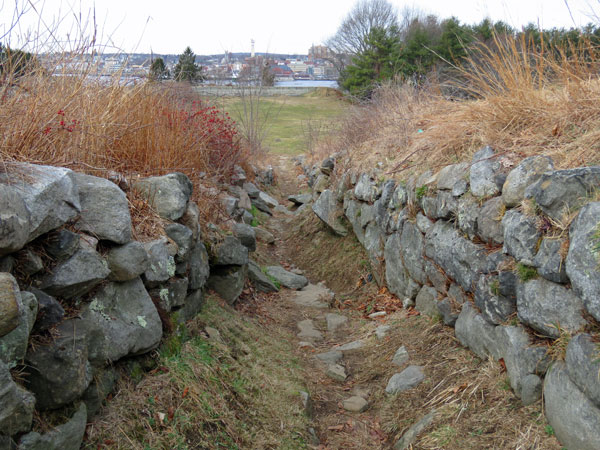
From the tunnel we followed a trench down the hill. The trench hid the soldiers from enemy fire as they moved between the fort and the lower battery.

view from the trench
looking down the trench, it turns to the left ahead
after the turn, getting closer to the end
powder magazine, built in 1843
looking up at the fort, the trench zig zags to the right

Off to the side on the lower battery is the restored Ebenezer Avery house. It was moved to this location from a nearby street in 1971.

In the old times, women did not get their lives written, though I don’t doubt many of them were much better worth writing than the men’s.
~ Harriet Beecher Stowe
(The Pearl of Orr’s Island: A Story of the Coast of Maine)

Anna Warner Bailey

Sometimes I think that historical houses should be named after the wives and daughters who lived in them, to honor them, as they very likely spent more time working there than the men who were out and about in the world.

But on a plaque outside this house I found a picture of Anna Warner Bailey (1758-1851) and the note that she was one of the first women to tend to the wounded after the battle. When I got home I found this online: Our Petticoat Heroine by Carol Kimball

We’ll have to wait until the pandemic is over before we can tour the house. I discovered a bit of synchronicity, we happened to be visiting this place on the 170th anniversary of Anna Warner “Mother” Bailey’s death. And there is a house named for her close by, where she had lived.

entrance gate and Groton Monument, seen from lower battery

The Groton Monument was built between 1826 and 1830, and is the oldest monument of its type in the country. Built of granite quarried locally, the Monument stands 135 feet tall with 166 steps.
~ Fort Griswold Battlefield website

We will also have to wait until the pandemic is over before we can tour the monument and small museum.

When I was preparing this post I noticed I already had a category for Fort Griswold Battlefield State Park. With another nod to synchronicity, it turns out Tim & I visited the fort nine years ago, almost to the day! The trench looks a little different nine years later. We had climbed up on the fort wall, which is no longer allowed. They have installed a viewing platform on the wall sometime in the past nine years. My, how things keep changing… The views of the river and city below are amazing. My old post: Fort Griswold Battlefield

ancestor hunting

Konrad Fusiak
my great-grandfather

My paternal cousin has been doing a lot of research on our Ukrainian roots and has shared some of her discoveries with me. Our grandparents spoke Ukrainian and emigrated from there in 1909 and 1910, but it seems our grandmother’s parents were originally from elsewhere. I’ve always considered myself half Ukrainian and identifying 41% “Eastern Europe & Russia” on my DNA test seems to bear that out.

But Ukraine wasn’t showing up looking closer under that broad Eastern Europe grouping. Instead, my DNA was indicating “Poland, Slovakia, Hungary & Romania.” And then my aunt’s DNA was matched with another family from Poland! (Apparently the DNA was too diluted for my cousin and me to show up as DNA matches with these distant cousins of our great-grandfather, Konrad Fusiak.) Here’s the tentative line, yet to be proven with documents:

Piotr Fusiak (b. 1760 in Lug, Małopolskie, Poland)
Gregorius Fusiak (b. 1798 in Lug, Małopolskie, Poland)
Gabriel Fusiak (b. 1827 in Zdynia, Małopolskie, Poland)
Konrad Fusiak (b. 1855 in Zdynia, Małopolskie, Poland)
Katerina/Katherine Fusiak (my grandmother, b. 1887 in Luzhek Verkhniy, Lviv Oblast, Ukraine)

Orthodox church in Zdynia by Tomasz Bienias

The province of Małopolskie is also known as Lesser Poland, a historical region. Zdynia is a tiny village, population 220. I can’t seem to locate Lug. (Perhaps it is Ług in Podlaskie?) From what I can tell from a cursory search there were several ethnic groups living in southern Poland. When my grandmother Katherine came to this country in 1910 she identified as a Ruthenian on the passenger ship manifest. Another aunt told me that Katherine’s mother, Ludmila Karaseck, was born in Prague and came to Ukraine to work in the salt mines. Wonder how she met Konrad from Poland? So many questions!!!

So, I’ve ordered a book, The Reconstruction of Nations: Poland, Ukraine, Lithuania, Belarus, 1569–1999 by Timothy Snyder, who “traces the emergence of Polish, Ukrainian, Lithuanian*, and Belarusian nationhood over four centuries.” I hope I can make some sense of the history of the region and gain some insight into my eastern European ancestry.

*Lithuania is a Baltic nation and in December 2019 I had 3% Baltic DNA. In September 2020 my son had 3% Baltic DNA and I didn’t show any. It seemed to be replaced with 3% Balkans. I suspect a mistake was made somewhere along the line. It will be interesting to see what shows up the next time they do an update/adjustment! See: ethnicity estimates.

Last Revised: 24 February 2022

shades of scarlet, saffron, and russet

10.24.20 ~ Connecticut College Arboretum
New London, Connecticut

Autumn that year painted the countryside in vivid shades of scarlet, saffron, and russet, and the days were clear and crisp under the harvest skies.
~ Sharon Kay Penman
(Time & Chance)

a copper and butterscotch harvest

The Connecticut College Arboretum Facebook page invited us over to check out the fall colors in all their glory. We were not disappointed! I had been reluctant to visit because New London was a designated coronavirus “red alert town” but now that Groton is, too, we decided we didn’t have much to lose.

black oak

One very nice feature of an arboretum is that many of the trees have identification tags on them.

fringe tree

In June, the above fringe tree has spectacular white fringe-like blossoms. (Janet may remember them!) To see a picture scroll down to the last few pictures on this post: late spring in the woods.

sweetgum
tulip tree
a maple (no tag)

But autumn leaves have another than their natural history — like autumn sunshine they have merits that concern the rambler, who cares not a fig for their botanical significance — what may be called their sentimental history.
~ Charles Conrad Abbott
(Days Out of Doors)

russet majesty
grove on top of a hill
evidence of the severe drought in the pond
blueberry growing out of glacial erratic in the middle of the pond
glacial erratic framed in saffron
(probably) ruby slippers hydrangea spent blossoms
(probably) ruby slippers hydrangea leaves
thanks to Melissa for help with identification
we got a little bit lost in there
heritage river birch

This might be my favorite tree in the whole arboretum. It is so tall there is no way I could get a picture of all of it. The texture of the bark is a pleasure to behold. The trunk splits in two and the view between them is spectacular. I love its energy. I have a dwarf river birch in my garden. It’s not nearly as tall.

looking up
looking out over the arboretum

We had walked for over an hour and I came home finally feeling satisfied that I hadn’t missed anything this autumn had to offer. 🙂

Augusta Jean & Jon Stephen

Augusta Jean Chomiak (1913-1986)
Jon Stephen Chomiak (1909-1919)
c. 1914

This picture is special to me because it is the only picture I have of my uncle Jon, who came to America with his mother when he was only 5 months old. He was born in Ukraine on 19 September 1909 and arrived on the SS Finland at Ellis Island in New York City on 4 March 1910. Sadly, he died at home of appendicitis when he was only 9 years old. His family was living in Buffalo, New York at the time.

At the time this picture was taken his older sister Mary was still living in Ukraine with their grandparents. The youngest four children (Lillian, Olga, Theodore, Ludmila) had not been born yet. There is a mystery child mostly unaccounted for, a boy named August or Augustine. No one seems to know anything about him except that he died as a toddler after ingesting something stored under the kitchen sink. I can find no birth or death records for this child, but it seems he was younger than Jon and older than Augusta Jean. It seems likely to me that Augusta was named after her brother who had probably died shortly before she was born.

Oddly enough, when one of my aunts filled out a family group sheet for me she gave August’s birth date as the same date as Augusta’s, leading me to consider that perhaps they were twins, however no one else in the family thinks this is likely. But it does seem likely that August was born in 1911 because Jon was born in 1909 and Augusta was born in 1913 and at that time most siblings were born about two years apart. And Lillian was born in 1915.

Anyhow, my Aunt Lil remembered that Jon was buried in “Father Baker’s Cemetery” in Lackawanna, New York. On a 2002 summer trip to western New York, we found the cemetery, which is now known as Holy Cross Cemetery, but we were disappointed to find no record of his burial in the office and no death certificate in the city hall. (Years later I discovered the family was actually living in nearby Buffalo, according to 1920 census records.) The kind people at the cemetery said that there were many graves not yet recorded in their database.

Aunt Lil remembered Jon fondly as a very loving big brother who bought his little sisters Jean (she went by her middle name) and Lil candy whenever he could. He was an altar boy at the church, and helped the family out by collecting coal from the railroad tracks, which we also located. We discovered quite a bit about Father Baker (1842-1936), and learned that the church where Jon must have served was replaced by the Basilica of Our Lady of Victory (consecrated 26 May 1926), which we toured.

Aunt Lil was four years old when her beloved big brother died and she spoke of him often through the years. Aunt Jean was six years old when Jon died. The middle name given to her only son is Jon. Lil and Jean were seven and nine years old when their baby brother, my father, came along. According to him they teased him relentlessly. 🙂

Today is Jon’s birthday and also the 7th anniversary of my father’s death. A bit of synchronicity that I would stumble across this picture today when I was looking for something else.

Last Revised: 10 September 2024

persuaded to live with trees

5.14.20 ~ The Merritt Family Forest, Groton, Connecticut
a colonial stone slab bridge crosses Eccleston Brook
This property was acquired by the Groton Open Space Association
in May of 2008
5.14.20 ~ robin in the Merritt Family Forest
I loved the way this tree was growing on a flat stone “stage”

The tempered light of the woods is like a perpetual morning, and is stimulating and heroic. The anciently reported spells of these places creep on us. The stems of pines, hemlocks, and oaks, almost gleam like iron on the excited eye. The incommunicable trees begin to persuade us to live with them, and quit our life of solemn trifles. Here no history, or church, or state, is interpolated on the divine sky and the immortal year. How easily we might walk onward into opening the landscape, absorbed by new pictures, and by thoughts fast succeeding each other, until by degrees the recollection of home was crowded out of the mind, all memory obliterated by the tyranny of the present, and we were led in triumph by nature.
~ Ralph Waldo Emerson
(The Essays of Ralph Waldo Emerson)

living with trees

The Merritt Family Forest is part of a large block of forested open space. The upper portion includes a steep, rocky, wooded upland with a mature hardwood forest. Descendants claim the forest remained uncut since the family acquired the property in 1848. The lower portion includes a meadow, and hosts a Tier 1 vernal pool and two Class A streams – Eccleston Brook and an intermittent tributary. Eccleston Brook flows into Palmer Cove, Fisher’s Island Sound and Long Island Sound.
~ Groton Open Space Association website

glacial erratic
moss
ferns
5.14.20 ~ Jack-in-the-pulpit, side view
5.14.20 ~ Jack-in-the-pulpit, front view

I had an especially good time enjoying the paths through the trees on that lovely, warm spring day. And I had an enjoyable afternoon creating this post today, a month later. A pleasant memory to savor. It’s been rough the past few weeks, battling the poison ivy. Tomorrow will be my last dose of prednisone and it will be nice to say goodbye to its side-effects, for me, anxiety and a headache. It’s no fun being up half the night with a panic attack! I’m ready to start living again. 🙂

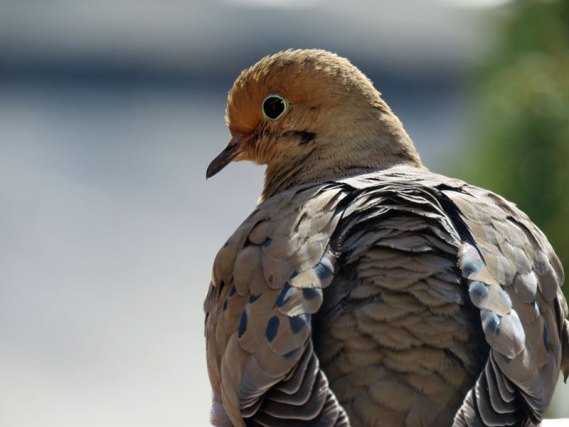
visit from a mourning dove

4.19.20 ~ mourning dove on my balcony

Mourning doves have been visiting me off and on since my mother died twenty-eight years ago. They seem to arrive when I could use a little encouragement. When I used to garden one would often sit near me and watch me as I worked. Once one walked with me all the way from my garden to the swimming pool in our complex. Lately one comes to sit on the balcony almost daily and coos for as long as an hour at a time. I find her company very comforting.

Sunday morning I decided to try to photograph her through the sliding glass doors and was thrilled with the results. She didn’t seem to mind posing. I know they are plain birds, but that’s exactly why I find them so beautiful! I love them the same way I love my gulls.

In this sad world of ours, sorrow comes to all; and, to the young, it comes with bitterest agony, because it takes them unawares. The older have learned to ever expect it.
~ Abraham Lincoln
(Letter to Fanny McCullough, December 23, 1862)

When I first read the Lincoln quote six years ago, after my father died, I remember thinking how true it was. When my mother died I was so young it came as a terrible blow and I needed therapy to work through the grief. By the time my father died it was no longer such a shocking experience. I deeply felt the pain of loss, but it wasn’t unexpected.

We now have 36 confirmed cases of COVID-19 in our town. There are moments I feel terribly anxious about this. It’s starting to sink in that it may be be many months or even more than a year before it will be safe to visit our grandchildren again. As it stands now, I don’t think I will feel free from danger before there is a vaccine. But we are trying to make the best of it and even find a sense of humor at times.

I find myself wondering how my parents would respond to the coronavirus pandemic. I imagine they would probably be just as blindsided as the rest of humanity. But since Mother Nature sees fit to send me such a sweet comforter as this lovely mourning dove I will stay grateful.

It’s not true that life is one damn thing after another — it’s one damn thing over and over.
~ Edna St. Vincent Millay
(Letter to Arthur Davison Ficke, October 24, 1930)

this might be my favorite pose

The Millay quote has been one of my favorites for a long time. It amuses me and helps me to laugh at the ironic situations I think I find myself in. The coronavirus pandemic feels unprecedented, and perhaps it is in my lifetime, but not at all in the history of the world.

In the trilogy Kristin Lavransdatter by Sigrid Undset, the protagonist, Kristin, dies from the Black Death at the end. It’s one thing to read about plague statistics in history books, quite another to experience what it must have been like while reading the words of an excellent storyteller. It comforts me to know others have felt the same fear.

Being a highly sensitive child, whenever I would lament about the sad things happening in the world my father would sigh and advise me, “‘Twas ever thus.” When my mother was dying of cancer and my heart ached for her suffering he would gently remind me that “every creature struggles for life.” He was a naturalist and scientist who taught us compassion for animals and people, but also prepared us for loss. Whenever one of our pets died he would tell us to “remember the good times.” I am so grateful for the lessons he taught me.

showing off her feathers

‘Twas ever thus — from childhood’s hour I’ve seen my fondest hopes decay, I never loved a tree or flower but ’twas the first to fade away.
~ Charles Dickens
(The Old Curiosity Shop)

my maternal-line great-grandmother and her children

Annie Eliza Baker (1845-1927), center front, and her three children:
William Nelson Hamblin (1883-1958), Amanda Eliza Hamblin (1879-1966),
and Benjamin Francis Hamblin (1873-1955).

Annie Eliza Baker is my 2nd-great-grandmother and her daughter, standing behind her, Amanda, is my great-grandmother, Mum, who died when I was 9 years old. I adored my great-grandmother. She was the one adult who seemed to understand my baby doll was “real.” She once admonished me for leaving the baby too close to the edge of the couch where she could easily fall off.

My cousin sent me this picture recently and now I can picture what my great-grandmother looked like as a young woman. Two women in my direct maternal line.

Annie and Amanda both married sea captains. Sadly Annie’s husband died a month and a half before their last child William was born. And their first son died when he was only 11 days old. Annie never remarried.

The biographical sketch I wrote about this family can be found here.

The Norwich Ovoid Carver

At the Groton Public Library we found the above book in the James Streeter History Room. Unfortunately, the identity of the carver of the unusual gravestones we discovered in the Avery-Morgan Burial Ground is lost to history, but he is referred to as the Norwich Ovoid Carver.

Particularly in the old Norwichtown burying ground, but also in Windham, Groton, Preston, and Coventry, one finds a small number of large rude semicircular stones that are among the earliest carved stones in the area. They are not just the crude initialed carving found in many inland cemeteries. These stones have obviously been shaped and the fronts smoothed. There is no attempt at designs, but the lettering is deeply and boldly cut and has remained legible for over two hundred years, often without appreciable deterioration. The Groton stones are particularly clear, but may well have been recut. There is something appealing in the elemental cleanness and strength of these early stones. They give one the impression of a society determined to remember its founders forever with no nonsense about it.
~ James A. Slater
(The Colonial Burying Grounds of Eastern Connecticut & The Men Who Made Them)

Besides the four gravestones in Groton, there are thirteen more found in Norwich, three in Preston, two in Windham and one in Coventry.

ethnicity estimates

Barbara’s latest ethnicity estimate from Ancestry DNA

Eastern Europe & Russia 43%
England, Wales & Northwestern Europe 28%
Germanic Europe 20%
Ireland & Scotland 3%
Baltics 3%
Norway 2%
Italy 1%

We recently added more ethnicity populations and communities. Based on this update, you might see changes to your results.
~ Ancestry.com

Tim’s latest ethnicity estimate from Ancestry DNA

England, Wales & Northwestern Europe 71%
Ireland & Scotland 21%
Germanic Europe 6%
Norway 2%

The last time we examined our DNA results was in 2014, about 5 years ago. (penetrating the past) We both have some interesting changes in our results!

For me, the Italian connection all but disappeared, which seems about right because I could never find one on the paper trail. Norway shows up solidly in about the right amount for my 3rd-great-grandfather, and Ireland as well, for his wife, my 3rd-great-grandmother. My father’s Slavic (Ukrainian) origins gained a larger percentage in my DNA. I’m intrigued with a new category, 3% Baltics (Estonia, Latvia, and Lithuania).

Interestingly, Tim also seems to be 2% Norway. But he’s a whopping 92% England, Wales, Scotland, Ireland and Northwestern Europe. And this analysis turns up absolutley no European Jewish ancestry, in spite of having a Jewish maternal grandfather. Still a mystery.

So, on Christmas Eve, we were sitting around our table working on a jigsaw puzzle and listening to holiday music with my sister and brother-in-law. I had made the shuffling playlist for my iPod years ago and had included tunes from many traditions. When the Dreidel Song came on my sister asked Tim if his family had celebrated Hanukkah when he was a child. The answer was no, although his stepgrandmother often brought Jewish foods to the house during the holidays. And then, much to my astonishment, he mentioned that his maternal grandfather had converted to Judaism. What!?!

This definitely would explain the lack of European Jewish ancestry for Tim!

It never ceases to amaze me how memories are stirred up in the oddest ways. And how a non-genealogical question lead to a spontaneous answer containing an important clue, which led to the solving of a genetic conundrum.

It will be fun to see any future changes in our DNA analyses as the scientists fine-tune the estimates as their population samples continue to grow.