sandhills pyxie-moss

1.28.24 ~ North Carolina Botanical Garden

It’s been a challenge getting outside with all the rain we’ve been getting lately. It was drizzling when we got to the botanical garden Sunday afternoon, even though the weather people had promised that the sun would be coming out. We decided to walk anyway.

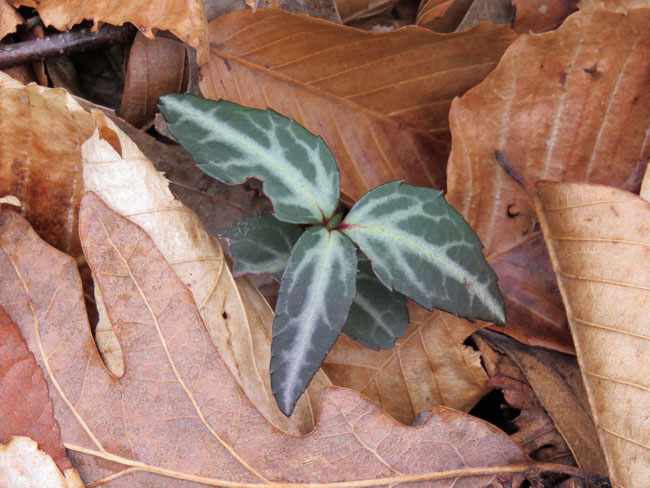
Along the path we met a staffer named Lauren, who was out in the rain looking for salamanders. We fell into a nice conversation and when we told her about our hunt for seedbox a couple of weeks ago she suggested another plant for us to hunt down. A tiny pyxie-moss was flowering now. She showed us a picture of it on her cell phone, and gave us directions to its location. We found it!

By then it had stopped raining so I went back to the car and got my camera. What a treat to see this plant so rare and unique to the Carolinas!

A rare minute creeping subshrub of xeric areas in the Sandhills region of North Carolina. This is the smaller of our two species of pyxie-moss. Very range-restricted, the entire known range of this species is a handful of counties in North and South Carolina.
… The tiny succulent evergreen leaves are less than 5 mm long. … The flowers rarely set seed and the seeds rarely sprout.
~ Carolina Nature website

After enjoying our discovery we went on to explore more of the soggy gardens. There is always something different to see. It was still a damp, gray day.

pretty sure this is a longleaf pine

This resurrection fern was growing abundantly on one side of a tall tree stump. On the other side of the stump it was all mushrooms.

I couldn’t get around to the back of the stump for a full all-mushroom shot, but you can see where the ferns ended and the mushrooms began in the photo below.

I close my eyes and listen to the voices of the rain. … Every drip it seems is changed by its relationship with life, whether it encounters moss or maple or fir bark or my hair. And we think of it as simply rain, as if it were one thing, as if we understood it. I think that moss knows rain better than we do, and so do maples. Maybe there is no such thing as rain; there are only raindrops, each with its own story.
~ Robin Wall Kimmerer
(Braiding Sweetgrass: Indigenous Wisdom, Scientific Knowledge & The Teachings of Plants)

lichens on a fallen branch
‘lemon drop’ swamp azalea buds
‘Spain’ rosemary flowering
Atlantic ninebark (rose family) seed head
Ozark witch-hazel blooming
witch-hazel marcescence
winterberry aka black alder

And you know the light is fading all too soon
You’re just two umbrellas one late afternoon
You don’t know the next thing you will say
This is your favorite kind of day
It has no walls, the beauty of the rain
Is how it falls, how it falls, how it falls

~ Dar Williams
♫ (The Beauty of the Rain) ♫

Lauren had mentioned that rainy days are the best time to look for salamanders. On warm wet nights from January to March here in the Piedmont they emerge from their underground burrows and head for vernal pools to mate and lay eggs. A week after that artic blast it did get unseasonably warm. I wonder if she found any salamanders after we talked. We kept our eyes open but didn’t see any.

fading autumn

11.19.23 ~ Bolin Forest, Carrboro, North Carolina

On a chilly Sunday morning my friend Susan came over so we could take a very local wander in the woodlands. Susan has been living in this area many years so she led the way. Down the hill from us, on the edge of the neighborhood, is Bolin Creek, which runs through Bolin Forest. It might become a go-to place for Tim and me when we don’t want to have to drive somewhere for a nice walk.

crossing Bolin Creek
looking up Bolin Creek
reflections
beech leaves and shortleaf pine (?) bark
little holes in the bark might be resin pockets

A very unique bark characteristic separating shortleaf pine from loblolly, longleaf, and other southern pine species. These are resin pockets, also described by various references as “spherical pitch pockets,” “small spots of resin,” and “volcanoes.”
~ N.C. Cooperative Extension website

heavily shaded pine grove
eastern white pine (?)
marcescence with pine backdrop
leaf dam in Bolin Creek

Your thoughts don’t have words every day
They come a single time
Like signal esoteric sips
Of the communion Wine

~ Emily Dickinson
(The Poems of Emily Dickinson, #1476)

waterbirds in the tidal marsh

1.30.23 ~ Waterford Beach Park

It was a rare day with calm winds so, even though it was cloudy, we went to walk along a tidal marsh by the sea. The first thing to catch my eye was a gorgeous little oak tree, still hanging on to its leaves. Then I spotted a pair of hooded mergansers in the distance, so these pictures are heavily cropped. The female kept diving for food but the male seemed to be resting.

female hooded merganser
male hooded merganser

A tidal creek runs through the marsh.

trees reflected in the water in the tidal creek

A solitary herring gull was floating around aimlessly, slowly drifting in my direction. Wondering where all the others have gone. They always seem willing to pose for me.

Somewhat disappointed by the lack of bird sightings we were on our way back to the car when I spotted a great blue heron on the other side of the marsh. Just as I got into a good position to photograph him, he took off! Frustrating… But, lucky for me he was just headed for a spot even closer to me and the other birds. Yay!

great blue heron, hunting
noticing something in the water
getting ready to strike
making a stab at it
oh well, not this time

I’ve been getting pictures of great blue herons for a few years now and this was the first time I’ve had one facing the camera. I had never noticed that pretty pattern running down the front of its neck before! It’s not even illustrated in my field guide. So I’m very excited about my new “discovery.”

winter wanderings

1.22.23 ~ Leo Antonino Preserve, Groton, Connecticut
first brook crossing on the yellow trail

On a cold and cloudy winter morning we decided to explore a relatively new open space property pretty close to home. Leo Antonino Preserve was acquired by the Avalonia Land Conservancy in 2018. What a pleasant surprise we had as we meandered along the loop trail, so many twists and turns, ups and downs and bubbling brooks to cross. We haven’t had any accumulating snow this January, not even a coating. But the woods did smell like winter and the crisp cold air soon gave us rosy cheeks and runny noses.

spotted wintergreen

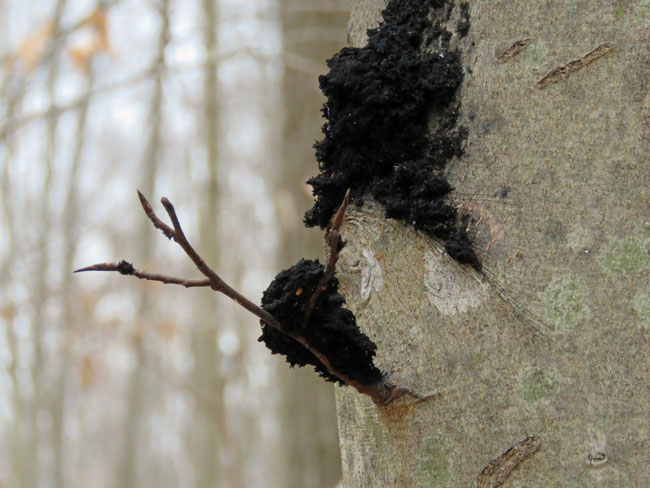
We were curious about this mysterious black stuff we saw on lots of the beech trees. Is it another symptom of beech bark disease?

The Leo Antonino Preserve is an unexpected tract of woods, wetland, rock outcroppings and erratics … The trail includes short sections of wide-open travel on packed earth and longer stretches of single-file trail that are rocky and rooty with elevation changes. The trail travels through areas of beech and oak and along vernal pools and active brooks. Erratics and upthrust sections of granite illustrate the geologic history of this section of Connecticut. Also illustrative of the history of this property, the yellow trail features the wreck of an old Chevy truck. The section of the yellow trail north of the Chevy is the most challenging with a scramble over a steep rocky ridge.
~ Avalonia Land Conservancy website

beech marcescence
very green mosses were everywhere

We made several crossings over a (or two?) brook. There were no bridges so we used the stepping stones, feeling grateful that we didn’t slip on the mosses!

another crossing
Tim left the trail, climbed the hill and then appeared from behind these erratics
yet another crossing
the wreck of an old Chevy truck
spotted wintergreen
a rusting metal circle hanging from a branch
ferns growing on top of a rock outcropping
lichen with moss
moss and lichen on different levels
sitting on top of a rocky ridge
American wintergreen
woodpecker work, I presume
???

Near the end of the trail we spotted these black lines on the path. I can’t help wondering if it’s the same black stuff we saw on the beeches…

I’ve been trying to be more selective and to include fewer pictures in my posts, but I had to make an exception for this one. When we started this hike I didn’t expect to take many pictures but it seemed like around every turn there was something interesting to notice. We’re looking forward to returning and trying the blue trail through these woods.

moments of wonder and joy

1.7.23 ~ song sparrow at Moore Woodlands

Resuming our walks! When we arrived at Moore Woodlands the birds were singing and it sounded like spring. It was 44°F/7°C and cloudy on this warm-for-January day. As we started walking around the meadow a song sparrow came down to the bushes and started singing for us. This made my whole day!

standing out in the meadow
lone tree in the meadow
beech marcescence

It is not enough to weep for our lost landscapes; we have to put our hands in the earth to make ourselves whole again. Even a wounded world is feeding us. Even a wounded world holds us, giving us moments of wonder and joy. I choose joy over despair. Not because I have my head in the sand, but because joy is what the earth gives me daily and I must return the gift.
~ Robin Wall Kimmerer
(Braiding Sweetgrass: Indigenous Wisdom, Scientific Knowledge & The Teachings of Plants)

wondering what those rusty maroon blobs are growing with the reindeer moss
~ amber jelly roll mushrooms ~
(thanks to Eliza for the identification)

In the woods we found a great many eastern red cedar trees that must have come down in a storm. Where they fell across the trail they had been cut and moved off to the side. It was interesting seeing the redness of the freshly cut wood.

We also saw a lot of English ivy growing on the ground and climbing some of the trees. I did some research when I got home and learned that the ivy is invasive and greatly weakens the trees they climb, making them more likely to fall during strong winds. It looks like the Avalonia Land Conservancy has been working to remove the ivy from this patch of woodland. We also saw quite a few eastern white pine saplings.

It also looks like the land conservancy is starting to identify the trees with little tags! I’d like to get more familiar with our local trees and welcome this new aid. This was a lovely first walk for the new year. 🙂

woodland treasures

8.15.22 ~ Beebe Pond Park

Scenes from a wonderful late summer walk on an incredibly beautiful day. No humidity, comfortable temperatures in the 70s, and no mosquitoes, no doubt thanks to the continuing severe drought.

hiding in plain sight
walking over roots and around boulders to get to the pond
great blue heron way across the pond
tiny flower with orbs
Beebe Pond during severe drought
water lilies carpeting the low water level
buzzy
no standing room
a giant
(there’s a little chipmunk sitting on the rotting wood under the erratic)
hiding under the giant
as far as the eye can see, an endlessly rocky trail
the space between
impaled
marcescence
marching to the beat of a different drummer
the lofty oak

When we had arrived at the park we saw two cars from a dog day care business and wondered what situation we might encounter on the trail. Much to my relief we crossed paths with two women walking eight medium-sized dogs on leashes. The dogs were well-behaved and minding their own business. (No tugging, lunging or barking.) Cesar Millan would have approved. 🙂 I was impressed!

to the dinosaur place

4.1.22 ~ The Dinosaur Place
Oakdale, Connecticut

Kat’s last day with us turned out to be the season’s opening day at the Dinosaur Place. We were there when the doors opened and were the first visitors of the year! It was a chilly, dreary day and we were sprinkled with occasional raindrops, but we had fun in spite of the dismal weather.

First we spent a lot of time watching Kat play in the T-Rex Tower at Monty’s Playground. While we were waiting for the attendant to dry off its surfaces we played a couple of rounds of hide-and-seek with our granddaughter. I can’t remember the last time I played hide-and-seek!

Then we started walking on one of the trails, noticing along the way just some of the 50 life-sized dinosaurs lurking in the woods. Kat followed the signs to Carnivore Cavern.

The first time through Grandpa was brave enough to go with her. They came out smiling but Kat was covering her ears and reported that it was VERY LOUD in there.

Then Kat announced that she was going to go through all by her self, and she did. 🙂

Then we found the A-MAZE-asaurus maze, complete with an observation deck, from where Grandpa and Grammy watched Kat try to make her way through. After a bit we offered suggestions. Good thing she knew her right from her left.

The exit turned out to be a tunnel slide, with a dinosaur mouth to pass through. Too bad we couldn’t scramble over there fast enough to see her at the top or landing at the bottom.

Then we followed the map to find the secret treasure, a large piece of quartz in the ground.

And some petrified wood…

And then Kat wanted to return to Carnivore Cavern to take me through. So I got a picture of inside the entrance.

And then it got very dark and then the dinosaurs in there roared. I managed to get a picture of one of the beasts!

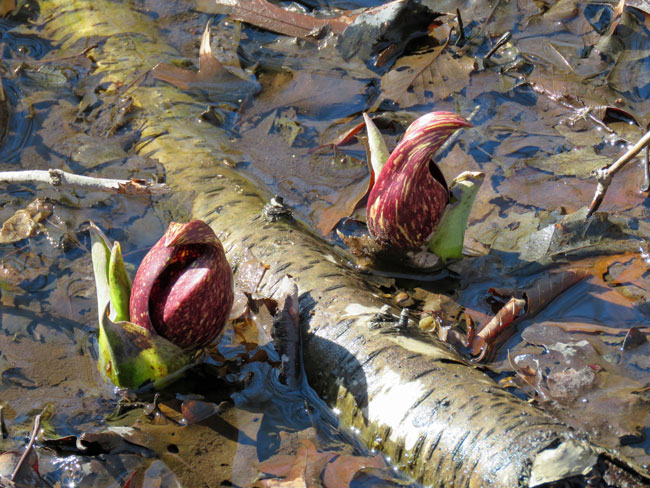
After we that we followed another trail. I couldn’t resist getting a picture of a skunk cabbage down in the swamp.

It’s fun seeing dinosaurs outside and getting a walk in the woods in at the same time.

Kat resting with Grandpa
waiting for Grandpa and noticing a lot of moss behind her
observing an abundance of mosses and lichens
the king of a rocky moss-covered mountain

On the way out Kat and her grandpa got some ice cream at The Village Ice Cream Shoppe, the first customers of the season. 😉 A perfect way to end the day. I hope we will be bringing Finn here, too, someday soon. 💙

It was almost nine years ago that Tim and I came here with our grandnephews, Julius and Dominic. I’m glad to have pictures and memories from that fun day, too. Pictures here. Those little guys are teenagers now!

a heavily wooded glacial valley

3.16.22 ~ Paffard Woods, Stonington, Connecticut

The preserve offers diverse terrain ranging from a heavily wooded glacial valley in the northern portion to a salt marsh on a tidal cove at the southern edge. Other distinguishing features include many glacial erratics, large trees, a white pine grove, wetlands crossed by bridges, and a cultivated field.
~ Avalonia Land Conservancy website

After several weeks of being plagued with gout/tendonitis/edema, Tim’s foot was finally healed enough to take a walk! Just in time to welcome some lovely warm spring weather. We chose a new-to-us preserve, Paffard Woods and walked for over an hour, much to my delight! It was a sunny day with temperatures around 50°F (10°C).

skunk cabbage coming up, early sign of spring
glacial erratic with a split hidden in the shadow
curious markings on tree bark
(thanks to Eliza for identifying beech bark disease)
a stone crossing ~ we made it across without incident
root covered terrain leading up to a nicely placed bench on top of a ledge
looking down at glacial erratics from the top of the ledge
moss on log illuminated by sunbeam

Even though these dark-eyed junco photos are marred by twigs I was excited to see them in the woods. They used to visit my birdfeeder when I had one but these are the first ones I’ve seen in the wild.

dark-eyed junco
tree/glacial erratic buddies

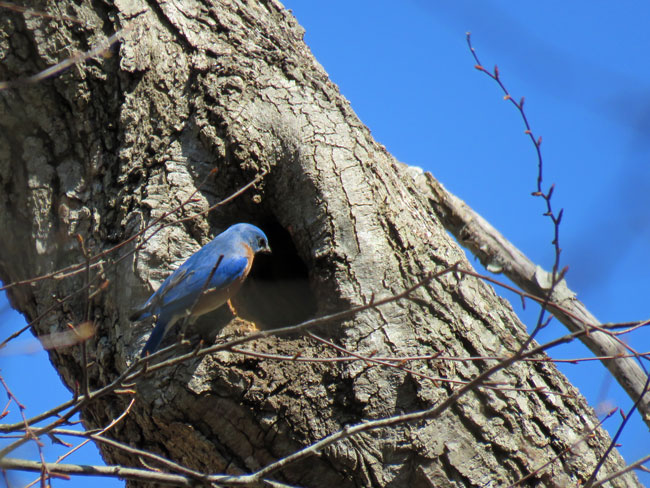
And then we saw a couple of eastern bluebirds flying to and from the hole way high up in this tree. Again, it was hard to get pictures with the twigs interfering with the focus. These were the best of my dozens of attempts! (Lots of shots with blurry wing action, too.)

eastern bluebird
trunk with many legs
trunk with many arms
more skunk cabbage
even more skunk cabbage
vine strangling a trunk
marcescence

Connecticut’s positivity rate has been hovering between 2-3%. There’s talk of a fourth shot being needed for those of us over 65. Still exercising a lot of caution in stores. Putin’s cruel onslaught on Ukraine continues. But it was good to forget reality for an hour and feel grateful for a brief dose of the healing power of nature.